Chapter 2: LLM Data Lifecycle and Quality Assessment Framework
Abstract
This chapter establishes the data quality assessment framework that underpins the entire book. "High-quality data" in large language model projects is not a single metric, but a multi-dimensional set of constraints that shift dynamically with the training stage, task objective, and business context. The chapter begins by explaining why algorithm, data, annotation, and product teams inevitably disagree on the definition of quality, and proposes a data quality terminology contract to unify communication. It then breaks down quality objectives, detection metrics, and typical risks for each of four stages: pre-training, instruction fine-tuning, preference alignment, and retrieval-augmented generation (RAG) deployment. A layered evaluation perspective is then constructed across the sample, batch, dataset, and system-platform levels. Finally, the chapter presents six core defect classes, a data release scorecard, CI/CD quality gates, and anonymized composite case studies to illustrate how quality assessment can be converted into executable governance actions, alerting strategies, and rollback mechanisms.
Keywords
Data quality assessment; data lifecycle; data scorecard; benchmark contamination; data governance; RAG evaluation; DataOps
Learning Objectives
- Establish a cross-team consistent vocabulary and metric language for data quality.
- Distinguish data quality objectives and evaluation methods across different training stages.
- Map common data defects to engineering metrics that are detectable, blockable, and auditable.
- Design data release scorecards, quality gates, and rollback workflows.
2.1 Why a Unified Quality Language Is Necessary
During large language model development, teams from different professional backgrounds often hold significantly divergent views on what constitutes "good data." This absence of a shared "quality language" is one of the principal causes of delays, rework, and unstable model performance in many LLM projects.
2.1.1 The Root Causes of Misunderstanding "High-Quality Data" Across Teams
In a typical large model R&D team, "high-quality data" means entirely different things to different roles. The following three anonymized composite scenarios synthesize disagreements commonly observed in joint review meetings on real-world projects, illustrating the risks of this cognitive gap.
Scenario 1: Algorithm Researcher vs. Data Engineer
Algorithm Researcher (examining the loss curve): "There's something wrong with your new data batch. You can clearly see the loss stopped improving after training step 8,000, and code generation capability has declined." Data Engineer (pointing to the quality report): "That's not right! The cleanliness score for this batch is 0.91, five points higher than the previous version. We specifically added stricter length filtering—this is the best version yet."
Root cause: The two parties are simply not talking about the same dimension of "quality." The strict length filter removed all long code snippets containing edge cases—improving quality on the "noise" dimension while degrading quality on the "coverage" dimension.
Scenario 2: Annotation Expert vs. Data Engineer
Annotation Expert: "The raw SFT data you gave me is terrible. Half the answers are factually wrong; some describe 2023 events as if they happened in 2021." Data Engineer: "I specifically ran perplexity filtering with KenLM on this batch, and the PPL distribution looks great—linguistic fluency is very high."
Root cause: Perplexity (PPL) measures "linguistic distribution plausibility"—a paragraph that is fluent but entirely factually wrong can have a very low PPL (appearing "good"). KenLM and other n-gram language models commonly used in pre-training corpus filtering use exactly this type of PPL score as a selection criterion (Heafield 2011). The "factual accuracy" that the annotation expert requires is a dimension that PPL filtering cannot cover at all.
Scenario 3: Product Manager vs. Algorithm Researcher
Product Manager: "The model is frequently hallucinating on users' financial questions online. Yesterday a user asked about a stock's dividend for this year, and the model confidently produced incorrect data from last year." Algorithm Researcher: "On our internal benchmark evaluation set, this model performs better than the previous version on financial knowledge question answering (QA)."
Root cause: The internal evaluation set's financial knowledge has a cutoff date from the previous year, while users online are asking about real-time information. The quality dimension of timeliness (Staleness) was simply not designed into the internal evaluation.
The common thread across all three scenarios: each party understands "quality" according to their own area of responsibility, but these local definitions do not form a shared metric framework, ultimately leading to systematic model performance deviations.
Implementation: A Workshop to Establish a Unified Quality Language
In most front-line large model teams, the effective solution is to mandate a Data Quality Definition Alignment Workshop at project kickoff (for systematic surveys of data selection methodology, see Albalak et al. 2024; Longpre et al. 2023; Nait Saada et al. 2025), producing an internal team document titled Data Quality Terminology and Metrics Contract. The first task of this document is to define a complete list of quality dimensions for the project—accuracy, diversity, duplication rate, timeliness, safety—and assign quantifiable calculation methods to each dimension, rather than stopping at qualitative descriptions.
Second, the document must define separate pass/fail thresholds for each training stage: the pass criteria for pre-training data and those for SFT data differ fundamentally in both magnitude and dimensionality, and should never be conflated. More importantly, the document must establish a precise mapping from terminology to code. For example, when any party says "duplication rate is too high," every member of the team must share the exact same understanding of those words: in engineering terms they mean "the proportion of sample pairs whose Jaccard similarity under a specific MinHash configuration exceeds the project threshold," not each person's intuitive sense that "this batch seems to have some repetition."
This contract document is not a static file but a versioned document that evolves continuously throughout the project. At every major milestone (for example, after a new model version is released), a retrospective must be held to examine whether existing metric definitions still apply at the new stage and whether they need to be extended or revised as the business context changes.
2.1.2 Why Quality Objectives Shift Dynamically Across the Data Lifecycle
Quality is by no means a static standard; it presents entirely different core requirements at different stages as the data lifecycle progresses. Applying a fixed standard to measure data across the entire lifecycle will inevitably produce serious misjudgments. As shown in Table 2-1, the core quality requirements and detection metrics differ significantly across the four stages of pre-training, instruction fine-tuning, preference alignment, and RAG deployment.
Table 2-1: Four-stage quality objective evolution matrix
| Training Stage | Typical Data Scale | Core Quality Requirements | Primary Detection Metrics | Typical Defects and Risks | Primary Processing Tools |
|---|---|---|---|---|---|
| Pre-training | Hundreds of billions to tens of trillions of tokens | High diversity, low duplication rate, broad knowledge coverage | N-gram duplication rate, PPL distribution, domain proportion, language distribution | Insufficient deduplication ("parrot" effect); benchmark data leaking in (inflated evaluation scores); excessive low-quality SEO content | MinHash / SimHash; fastText language identification; KenLM; Quality Classifier |
| Instruction Fine-tuning (SFT) | Tens of thousands to millions of instruction pairs | Instruction diversity, format compliance, complete reasoning chains | Instruction difficulty distribution, format compliance rate, factual accuracy rate | Near-duplicate instruction semantics ("approximate clones"); inconsistent answer formatting; factually incorrect answers | Rouge-L deduplication; GPT-4 fact auditing; format regex validation |
| Preference Alignment (RLHF/DPO) | Tens of thousands to hundreds of thousands of preference pairs | Distinctiveness of preference signal, value alignment, harmlessness | Annotator agreement Cohen's κ (Cohen 1960); quality gap between chosen/rejected; toxicity score | Inconsistent annotator preferences (κ < 0.6); insufficient gap between chosen and rejected (weak signal); presence of cultural bias | Multi-round calibration; Reward Model pre-filtering; Perspective API (Lees et al. 2022) |
| RAG Deployment | Thousands to tens of thousands of documents | Timeliness, business coverage, retrieval recall precision | Knowledge cutoff date distribution; scenario coverage recall; Faithfulness score | Stale knowledge base (not updated in 6 months); chunk granularity too coarse causing high retrieval noise; garbled PDF parsing | LlamaIndex / LangChain; RAGAs evaluation framework; Embedding quality evaluation |
From the table it is clear that even within "quality evaluation," the primary metrics shift entirely—from "deduplication rate and PPL distribution" in the pre-training stage to "annotation consistency and preference gap" in the RLHF stage. A dataset that is acceptable at the pre-training stage may fail at the SFT stage due to insufficient factual precision, format compliance, or task coverage. This stage-by-stage migration of quality objectives requires data engineering teams to establish Phase-Specific Quality Contracts rather than applying a single universal standard to all stages.
2.1.3 Governance Failures When a Unified Framework Is Absent
When a unified data quality assessment framework is lacking, the project will inevitably experience "governance failures." Typical symptoms include:
-
Metric Silos: The pre-training team uses perplexity (PPL) as the core script metric; the fine-tuning team uses ROUGE-L to measure response quality; the safety team uses Perspective API toxicity scores as compliance indicators. No shared language exists across the three systems. When a batch of data simultaneously triggers alerts from multiple teams, it is difficult to determine who should lead the remediation, or which metric carries veto power over release.
-
Noise Propagation Amplification: Without a unified framework, small amounts of upstream data pipeline noise often cannot be intercepted early and propagate down the pipeline, producing order-of-magnitude harm downstream:
Listing 2-1 provides a process flow example.
[Crawl/Storage Layer]   A small number of base64-encoded images are mixed into the text stream
      ↓  Not intercepted in time (no unified defect standard)
[Cleaning/Training Layer]  These garbled characters cause specific token frequencies to rise abnormally
      ↓  Noise is repeatedly reinforced through gradient accumulation
[Inference/Alignment Layer]  The model is more likely to produce garbled or format-abnormal output for certain content types
      ↓  Manifests as degraded online experience, triggering user feedback and version review
[Final Cost]     Model version forced to roll back, losing training compute and the market window
Listing 2-1: Process flow example
This amplification effect—"a small upstream error → a midstream distribution anomaly → downstream experience loss"—can be understood as cross-stage error propagation in the data pipeline. The governance solution is the unified quality gate system that this chapter will establish.
- Experience Loss: Because there is no unified defect classification standard, post-mortem conclusions after model failures typically stop at "the data was bad; we need to be more careful next time." Was it because of high duplication rates, imbalanced domain ratios, or benchmark contamination? Without clear classification, these lessons cannot be translated into concrete rule modifications for the next version of the cleaning pipeline. After introducing a unified quality framework, every data issue can be attributed to a specific defect type (see Section 2.3) with corresponding remediation operators and quantified improvement targets. Post-mortem documents should evolve from "the data was bad" to "root cause of this incident: duplication rate exceeded the project threshold; remediation plan: recalibrate deduplication thresholds by domain and remeasure the deduplication rate in the next incremental validation."
2.2 Layered Quality Objectives from a Data Lifecycle Perspective
To resolve the problem of an inconsistent quality language, we must establish clear "quality objective tiers" at each stage of the lifecycle. This multi-dimensional quality layering architecture is illustrated in Figure 2-1.
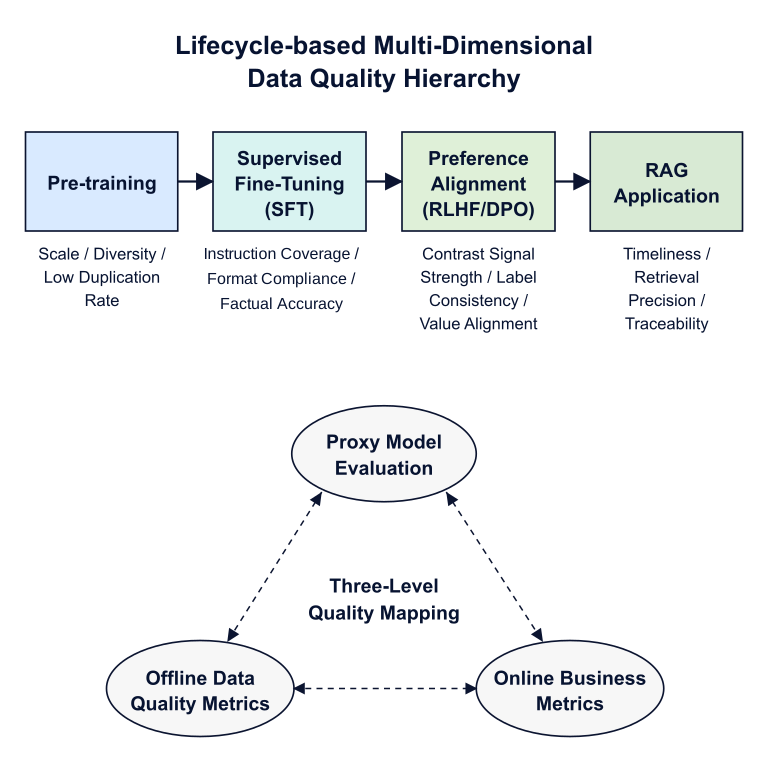
Figure 2-1: Multi-dimensional quality layering architecture
2.2.1 Quality Objective Differences Across Stages
Each stage in the large language model training pipeline has different quality objectives. Pre-training focuses on corpus scale, diversity, and low duplication rate; SFT focuses on instruction coverage, format compliance, and factual accuracy; preference alignment focuses on contrastive signal strength and annotation consistency; RAG deployment focuses on knowledge freshness, retrieval recall, and evidence traceability.
Pre-training is the first stage, with the goal of establishing broad representations of language, code, and knowledge. The requirement at this stage is not that every sentence be absolutely correct, but that the corpus be large in scale, high in diversity, and low in duplication. In an unsupervised fashion, the model encounters different domains, linguistic styles, and knowledge boundaries, building fundamental representational capability. At this stage, a slightly outdated popular science article is generally not the primary risk; however, the same SEO advertisement appearing thousands of times in the corpus will significantly increase the risk of generation degeneration and memorization-based overfitting.
Instruction Fine-tuning (SFT) is the second stage, where the quality objective narrows from "breadth" to "precision": instruction diversity, response format compliance, and complete reasoning chains are all indispensable. SFT is generally more sensitive to contamination than pre-training, because at this stage the model is learning task formats and interaction behavior; even a small number of format-inconsistent or logically erroneous samples can cause observable degradation on the corresponding tasks.
Preference Alignment (RLHF/DPO) is the third stage, where the core quality objective is the effectiveness of contrastive data and value alignment: the chosen answer must have a sufficiently distinguishable quality gap from the rejected answer (Ouyang et al. 2022; Rafailov et al. 2023; Bai et al. 2022); otherwise the reward signal is too weak and the model cannot learn a stable direction of human preference.
RAG Deployment is the fourth stage and the one closest to end users. Quality metrics here shift toward timeliness and retrieval precision: the proportion of documents in the knowledge base that have not been updated for more than six months, whether the retrieved chunks accurately cover the user's query intent, and whether PDF and table parsing introduces field misalignment. These issues do not always surface visibly in the first three stages, but in RAG scenarios they directly impact the quality of the final response.
2.2.2 The Triangular Mapping: Offline, Online, and Business Quality
Defining quality objectives separately for each stage is not sufficient—a mature data engineering framework must further bridge the complete "metric chain" from data to model to real business outcomes, rather than allowing "good data quality" and "good online performance" to remain two disconnected evaluation systems.
In industry practice, this metric chain is described as a triangular mapping structure. The first vertex is offline data quality metrics: static scores computable at the data storage and processing stage, including deduplication rate, mean PPL distribution, benchmark contamination rate, and so on. These metrics can be computed efficiently without running a model and are suitable for automatic triggering in CI/CD pipelines. The second vertex is proxy model evaluation quality: the processed data is injected into a small-scale proxy model (typically ~1B parameters) for fast training and testing, measuring the actual training value of the data through benchmark scores. This step is an indispensable "bridge validation" between offline data metrics and final model performance. The third vertex is real business online system quality: the actual user retention rate, satisfaction scores, and conversion metrics after model deployment.
In the ideal case, the three vertices should exhibit a stable positive correlation. Whenever one edge of this triangle breaks—for example, if offline data scores are high but proxy model scores do not improve, or proxy model scores are high but online user feedback is poor—this is a strong signal that the current evaluation framework has a systemic design flaw at some point, requiring immediate analysis of which metric has become decoupled from which, and tracing the root cause back to the data layer.
2.2.3 Cross-Section Layering: From Sample Level to System Level
Quality assessment also requires cross-section layering on the dimension of "granularity." Quality issues at different granularities differ in detection timing, remediation cost, and remediation approach. Conflating them easily leads to a mismatch between the remediation method and the problem tier.
The finest granularity is sample-level. This is the earliest detectable tier in the data pipeline: does this long text contain residual HTML tags? Is this image semantically aligned with its accompanying textual description? Is the answer in this QA pair severely misaligned with the direction of the question? Sample-level issues are large in volume but low in per-sample remediation cost, making them suitable for automated rule-based batch processing.
The next level up is batch-level. At this granularity, the focus is on the aggregate statistical distribution characteristics of a data batch: has this batch's domain sampling ratio deviated noticeably from the preset baseline? Has the ratio of code corpus to natural language text shifted abruptly because a particular crawler quota failed? Batch-level issues do not manifest in individual samples; they can only be detected in the statistical profile of the batch as a whole, and therefore require dedicated rolling distribution monitoring.
Above that is dataset-level, concerned with the macroscopic health of the entire training set: is the temporal distribution of knowledge in the entire corpus severely concentrated in a few years? What proportion of content has been flagged as high-risk in benchmark contamination detection? Do the proportions of different languages meet the multilingual training requirements? Issues at this tier are strategic in nature, typically completed by data engineering leads through manual review and report auditing before version releases, rather than relying on automated pipelines.
Finally, there is system-platform level: the operational health of the data pipeline as an engineering entity—has a Kafka consumer queue developed backlog? Did a particular version of the MinHash deduplication job silently exit early due to OOM, leaving large quantities of unprocessed duplicate data? Issues at this tier are not in the data content itself, but in the engineering quality monitoring of the data pipeline, which is a core concern of DataOps observability (covered in depth in Part VIII).
2.3 Defect Classification and Metrics Matrix
To establish shared governance actions, the vague notion of "bad data" must be translated into a specific, measurable defect metrics matrix. Figure 2-2 presents the cross-mapping relationship between six core defect classes and five core quality metrics.
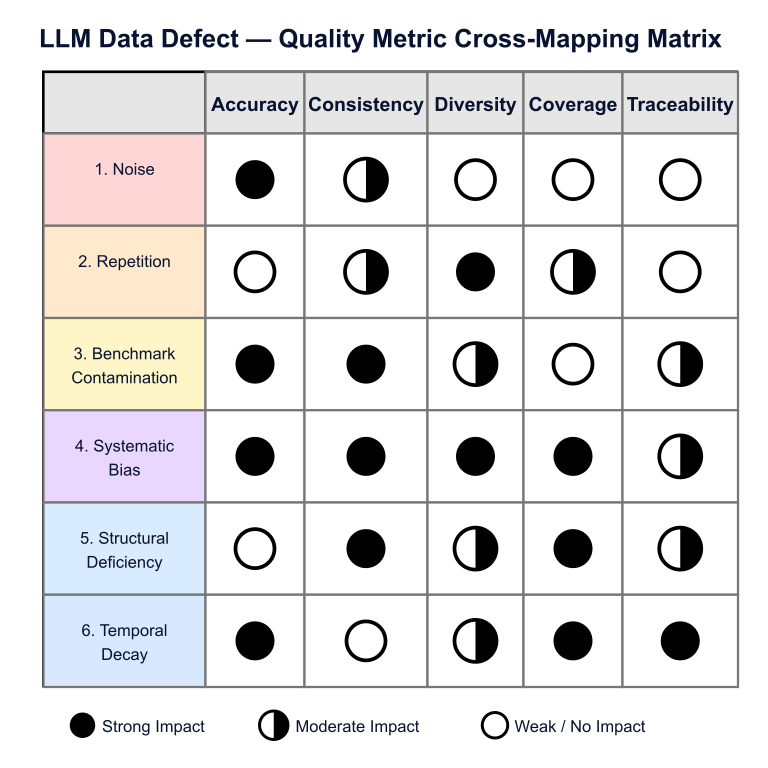
Figure 2-2: Cross-mapping matrix of data defects and quality metrics
2.3.1 Six Core Defect Classes (Six Core Defect Classes)
For large language model training, we establish the following six core defect dimensions, each accompanied by an automated detection approach:
1. Noise
Definition: Content containing residual HTML tags, garbled characters, meaningless symbol sequences, base64 encoding fragments, and similar artifacts. These produce abnormal inputs to the tokenizer and can cause gradient NaN values in severe cases.
Listing 2-2 shows a minimal detector for text noise ratio.
import re

def noise_score(text: str) -> float:
    """Returns noise ratio; thresholds must be calibrated by language, source, and spot-check sample."""
    # Detect residual HTML tags
    html_tags = len(re.findall(r'<[^>]+>', text))
    # Detect high proportion of non-printable characters
    non_printable = sum(1 for c in text if not c.isprintable())
    # Detect consecutive repeated symbols (e.g., !!!!!!!)
    repeat_symbols = len(re.findall(r'[^\w\s]{5,}', text))
    total = len(text) if text else 1
    return (html_tags * 10 + non_printable + repeat_symbols * 5) / total

# Example: when noise_score exceeds the project-calibrated threshold, send it to quarantine or manual review.
Listing 2-2: Example of text noise ratio detection
In production, add language, encoding, HTML parser version, and exception sample inspection logs.
2. Repetition
Definition: The same content (exact or approximate) appearing a large number of times in the training set, forcing the model to "memorize" these segments, causing memorization-based overfitting, and producing a "parrot" effect at inference time. Industry practice generally uses MinHash LSH for approximate deduplication.
Listing 2-3 shows an approximate duplicate detector based on MinHash LSH.
import re
from datasketch import MinHash, MinHashLSH

def build_minhash(text: str, num_perm: int = 128) -> MinHash:
    m = MinHash(num_perm=num_perm)
    tokens = re.findall(r"[\u4e00-\u9fff]|[A-Za-z0-9_]+", text.lower())
    for token in tokens:
        m.update(token.encode('utf-8'))
    return m

# Example threshold is for demonstration only; production thresholds must be calibrated
# by language, task, and false-rejection cost.
calibrated_threshold = 0.8
lsh = MinHashLSH(threshold=calibrated_threshold, num_perm=128)
Listing 2-3: Example of approximate duplicate detection using MinHash LSH
In production, record the threshold, partitioning strategy, and sampling review results.
3. Benchmark Contamination
Definition: Web crawlers indiscriminately ingesting the original questions and answers from publicly available AI evaluation benchmarks (GSM8K (Cobbe et al. 2021), HumanEval (Chen et al. 2021), MMLU (Hendrycks et al. 2021), etc.) into the pre-training corpus, causing inflated benchmark scores (rote memorization rather than reasoning). Systematic surveys of automated detection methods for this problem are available in Shi et al. (2023) and Golchin and Surdeanu (2023).
Listing 2-4 shows an N-gram overlap detector for benchmark contamination risk.
# Benchmark contamination detection: compute N-gram overlap rate
import re
from collections import Counter

def ngram_overlap(text: str, benchmark_ngrams: set, n: int = 13) -> float:
    """Returns the 13-gram overlap ratio with the benchmark corpus"""
    words = re.findall(r"[\u4e00-\u9fff]|[A-Za-z0-9_]+", text.lower())
    text_ngrams = set(
        ' '.join(words[i:i+n]) for i in range(len(words) - n + 1)
    )
    overlap = len(text_ngrams & benchmark_ngrams)
    return overlap / max(len(text_ngrams), 1)

# Example: when the overlap rate exceeds the project contamination-risk threshold,
# flag it as suspected contamination and review manually.
Listing 2-4: Example of N-gram overlap detection for benchmark contamination
In production, maintain an independent evaluation set fingerprint database and a manual review workflow.
4. Systematic Bias
Definition: Due to geographic, linguistic, or topical skew in the crawled data sources, the data exhibits systematic knowledge bias related to nationality, gender, race, ideology, and similar dimensions, causing the model to perform unevenly on tasks involving specific groups.
Detection approach: Use StereoSet (Nadeem et al. 2021) or WinoBias (Zhao et al. 2018) evaluation sets to assess the model's degree of bias; also compute the frequency distribution of terms related to sensitive groups (gender/ethnicity/religion) in the training set, checking for severe term-frequency imbalances (one group appearing more than 10 times as frequently as another).
5. Structural Incompleteness
Definition: Long texts that have been truncated (only the first half of an article), QA pairs containing only the answer without the question, multimodal data in which images lack accompanying textual descriptions, etc.
Listing 2-5 shows a simple structural completeness check for SFT samples.
def check_completeness(sample: dict) -> list:
    """Check the structural completeness of an SFT sample"""
    issues = []
    if 'instruction' not in sample or not sample['instruction'].strip():
        issues.append('missing_instruction')
    if 'response' not in sample or len(sample['response']) < 20:
        issues.append('response_too_short')
    # Check for truncation: text ends mid-sentence (no terminal punctuation)
    resp = sample.get('response', '')
    if resp and resp[-1] not in '.!?。!?…"\'':
        issues.append('possibly_truncated')
    return issues
Listing 2-5: Example of SFT sample structural completeness checking
In production, add schema validation, field-length distribution checks, and sampling review rules by task type.
6. Staleness
Definition: The knowledge base or pre-training corpus is frozen at a certain cutoff date and cannot reflect factual changes occurring after that date. This is particularly high-risk in RAG deployment scenarios.
Detection approach: Record a crawl_timestamp metadata field for every document in the corpus, and periodically compute the proportion of documents that have not been updated for more than N months. Dataset documentation standards such as Datasheets for Datasets provide detailed guidance for metadata fields (Gebru et al. 2021). Trigger a staleness alert when the proportion of outdated documents exceeds the project threshold.
Listing 2-6 shows how to compute a staleness ratio from document timestamps.
from datetime import datetime, timedelta

def staleness_ratio(docs: list, threshold_days: int = 180) -> float:
    """Returns the proportion of stale documents"""
    now = datetime.now()
    stale = sum(
        1 for d in docs
        if (now - datetime.fromisoformat(d['crawl_timestamp'])).days > threshold_days
    )
    return stale / len(docs) if docs else 0.0
# Example: when staleness_ratio exceeds the business-defined waterline,
# trigger a knowledge base update task.
Listing 2-6: Example of knowledge base staleness detection. In production, set different thresholds by domain, data source, and business priority
2.3.2 Establishing the Core Metrics Matrix
To quantify defects, this book uniformly adopts five core evaluation metrics:
- Accuracy: The proportion of data containing correct knowledge; the highest-priority metric for fine-tuning data.
- Consistency: Whether there are contradictions between upstream and downstream data or across modality combinations (logical consistency).
- Diversity / Entropy: The distribution of discrete spread across different topics.
- Coverage: The hit rate and recall of business scenarios in the data stream.
- Traceability: When an error occurs, whether low-quality data can be traced back through lineage to a specific web page or raw storage bucket (critically affects debugging efficiency).
2.3.3 Trade-offs and Conflicts Between Metrics
There is no perfect combination of metrics. Forcibly improving one metric often comes at the cost of another. For example:
- Deduplication (improving precision/avoiding overfitting) vs. Diversity: An overly strict MinHash deduplication threshold (e.g., discarding samples with similarity above 0.7) will eliminate many high-quality feature examples that differ only at fine-grained boundaries (such as template code), leading to degraded code capability.
- Accuracy vs. Timeliness: Requiring extremely rigorous expert-level human validation greatly extends the production cycle; by the time high-quality corpus is produced, the corresponding facts may have already changed.
2.4 From Scorecard to Governance Actions: Closing the Automated Filtering Loop
A quality assessment framework must ultimately materialize as concrete, engineered automated gates. We establish a closed loop by implementing a Data Release Scorecard. As shown in Figure 2-3, hard gates, soft gates, manual review, and rollback actions together form the automated blocking and governance flow driven by the data scorecard.
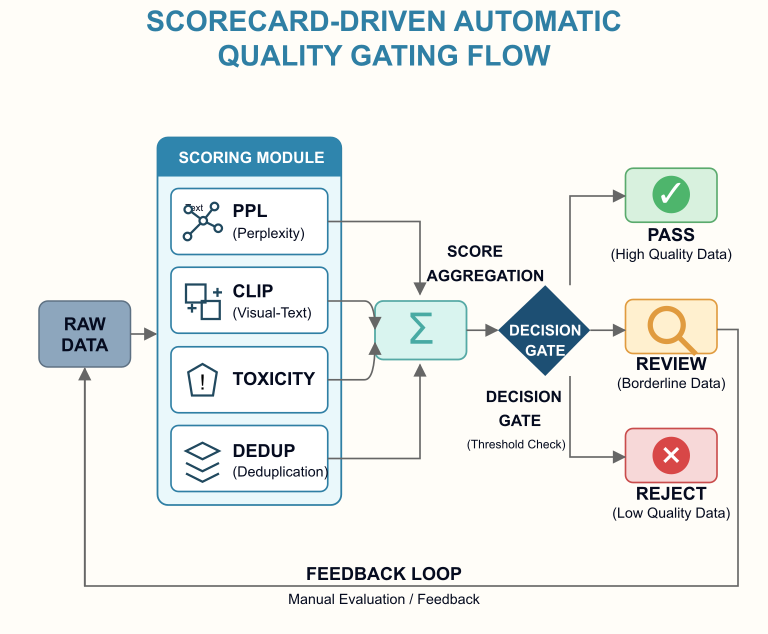
Figure 2-3: Automated blocking and governance flow driven by the data scorecard
2.4.1 Scorecard Design and Implementation
The scorecard is a "data health report" derived from a combination of rule scripts and validation models. Its core design principles are: objectively reproducible computation, configurable threshold baselines, and action-oriented blocking. Before officially releasing any version of a training dataset, the scorecard script must be mandatorily triggered, and the evaluation results must be serialized into a standard JSON format and archived. Listing 2-7 gives an example release scorecard schema.
{
  "dataset_id": "sft_zhcn_legal_v2.3",
  "evaluation_timestamp": "2024-11-15T10:23:45Z",
  "evaluator_version": "scorecard-v1.4.2",
  "sample_count": 84721,
  "scores": {
    "dedup_rate": {
      "value": 0.023,
      "threshold": 0.05,
      "status": "PASS",
      "method": "MinHash LSH (threshold=0.7, num_perm=128)"
    },
    "noise_score_p95": {
      "value": 0.067,
      "threshold": 0.10,
      "status": "PASS",
      "method": "HTML tag density + non-printable char ratio"
    },
    "benchmark_contamination": {
      "value": 0.0031,
      "threshold": 0.005,
      "status": "PASS",
      "method": "13-gram overlap against GSM8K/MMLU/HumanEval"
    },
    "format_compliance_rate": {
      "value": 0.9712,
      "threshold": 0.95,
      "status": "PASS",
      "method": "Regex schema validator (instruction+response fields)"
    },
    "staleness_ratio": {
      "value": 0.12,
      "threshold": 0.30,
      "status": "PASS",
      "method": "crawl_timestamp > 180 days"
    },
    "toxicity_p99": {
      "value": 0.041,
      "threshold": 0.05,
      "status": "PASS",
      "method": "Perspective API (TOXICITY attribute)"
    }
  },
  "overall_status": "PASS",
  "gate_decision": "APPROVED_FOR_TRAINING",
  "reviewer": "ci-bot@dataops.internal",
  "comments": "All hard gates passed. Soft gate: staleness_ratio=0.12 within safe range."
}
Listing 2-7: SFT dataset release scorecard JSON example
The schema is illustrative; production environments should calibrate fields, thresholds, and gate decisions by dataset type and risk level.
Listing 2-8 shows a GitHub Actions workflow for triggering the scorecard in CI/CD.
# .github/workflows/data_quality_gate.yml
name: Data Quality Gate

on:
  push:
    paths:
      - 'datasets/sft/**'   # Triggered on every SFT dataset update

jobs:
  quality_check:
    runs-on: ubuntu-latest
    steps:
      - uses: actions/checkout@v3

      - name: Run Data Scorecard
        run: |
          python scripts/run_scorecard.py \
            --dataset datasets/sft/latest/ \
            --config configs/scorecard_sft.yaml \
            --output reports/scorecard_$(date +%Y%m%d).json

      - name: Check Gate Decision
        run: |
          DECISION=$(python -c "
          import json
          with open('reports/scorecard_$(date +%Y%m%d).json') as f:
              d = json.load(f)
          print(d['gate_decision'])
          ")
          if [ "$DECISION" != "APPROVED_FOR_TRAINING" ]; then
            echo "Data quality gate FAILED: $DECISION"
            exit 1
          fi
          echo "Data quality gate PASSED"

      - name: Upload Scorecard Report
        uses: actions/upload-artifact@v3
        with:
          name: scorecard-report
          path: reports/scorecard_*.json
Listing 2-8: GitHub Actions example for CI/CD pipeline integration
This snippet demonstrates how quality gates are triggered; production environments should add credential management, log retention, and failed-run rollback strategies.
With this integration, every time a data engineer merges a new data batch, the CI pipeline automatically runs the scorecard check. If any hard gate metric exceeds its threshold, the PR merge is automatically blocked until the issue is resolved and the job is resubmitted.
2.4.2 Quality Thresholds, Blocking Gate Design, and Rollback
When a newly crawled 100 GB incremental data batch arrives in the pipeline:
- Hard Gates: If a significant rise in benchmark contamination rate is detected, or if a safety blocklist match is triggered, the pipeline is immediately blocked at this stage and an alert is automatically triggered (e.g., via PagerDuty).
- Soft Gates: If text complexity, length distribution, or domain proportion deviates noticeably from the previous version, the batch is temporarily quarantined pending manual confirmation—a state referred to as a "gray freeze."
If post-hoc monitoring reveals severe online model degradation caused by data issues, the DataOps platform must support rapid rollback to the previous "clean" data pointer combination.
2.4.3 Converting Alerts into Remediation Actions
Once a score anomaly is detected, alerts must be mapped to standardized remediation actions. For a contamination rate alert, an N-gram reverse filtering and removal job is launched. For a format validation failure (e.g., a data batch missing required fields), the import is blocked and the issue is traced to the specific raw crawler parsing script node for ETL field re-extraction. Only by having alerts directly drive the corresponding cleaning operators can governance form a closed-loop system.
2.5 Cross-Stage Propagation Amplification Case Studies
To deepen understanding of this "butterfly effect" data quality propagation mechanism, this section reviews two anonymized composite case studies. The timelines and metrics in the cases are used to illustrate the debugging logic and do not represent the complete event record of any public project.
2.5.1 Case Review 1: "Silent Grammar Drift" in a Pre-training Corpus
After a certain open-source model was released in 2023, it was discovered that code generation capability not only failed to improve as training steps increased, but actually began to degrade, introducing rare and unusual whitespace characters.
Root Cause Analysis: The team traced the most recently ingested data batch and found that during the language identification cleaning step, the package version of a certain HTML format filter had been upgraded. The new version caused a parsing failure for <pre> code tags that had previously been correctly skipped, resulting in a sudden 4x increase in the proportion of web source code containing special whitespace indentation in the final 1T of data. (This was a loss caused by the absence of a baseline check on the "consistency" quality metric.) The model had undergone a silent "distribution shift" over the course of long-term training.
Lessons and Post-Mortem: At the batch-level, there was a lack of long-window rolling stationarity monitoring of static distributions, which later forced the team to build a rolling N-gram distribution radar.
2.5.2 Case Review 2: "High Offline Score, Online Failure" in a RAG Scenario
After a financial knowledge QA model was SFT-trained on a batch of private research reports, its Rouge/BLEU scores on the offline evaluation set far exceeded the baseline model. However, after the business unit went online, they reported that the model frequently fabricated data (severe hallucinations) when encountering long-tail company research reports.
Root Cause Analysis: The research report QA pairs used for SFT training were generated by a weak model and were well-formatted, but upon inspection it was found that due to errors in table splitting and parsing, many financial figures were misaligned. The offline evaluation set was also generated by the same process, so the evaluation data shared the same type of parsing errors as the training data, causing Rouge/BLEU scores to significantly overestimate the true capability.
Lessons and Post-Mortem: This case demonstrates that self-referential evaluation and decoupling of offline and online metrics significantly amplify risk. After this version, the team introduced an Independent Gold Standard Evaluation Set, written independently by human experts, not participating in any model synthesis or generation pipeline, and used as a veto-capable pre-release evaluation set.
Complete Debugging Timeline (Case 1)
The following timeline is an anonymized composite case used to explain how batch drift can be localized. The version numbers, proportions, and evaluation values are instructional examples and should not be cited as results from a public project.
- T+0 day: Internal users report that Python code generation produces strange indentation, causing immediate
IndentationErroron execution - T+1 day: Algorithm team suspects a temperature parameter issue; adjustment has no effect
- T+2 days: Data team is brought in and retrieves data batch diffs for the most recent three checkpoints
- T+3 days: The team discovers that when batch 6 (approximately 1.2T tokens) was ingested, the HTML filter dependency was upgraded from v2.3.1 to v2.4.0; the new version changed the handling logic for
<pre>tags, incorrectly converting code indentation that should have been preserved into non-standard spaces - T+3 days: Quantitative validation shows that the proportions of
\t, consecutive spaces, and invisible Unicode whitespace in the new batch deviate significantly from the historical baseline, triggering a batch-drift alert - T+5 days: Lock the dependency version, reprocess batch 6, and restart training from the checkpoint before contamination (losing approximately four days of compute)
- T+12 days: After the fix, the frozen code evaluation set recovers to the pre-contamination baseline range
Root cause: absence of rolling distribution stationarity monitoring at the batch level. If key character-frequency Z-score changes had been compared automatically at every batch ingestion and abnormal fluctuations above the project waterline had triggered alerts, this incident could have been intercepted at T+0. Listing 2-9 shows a batch-level indentation drift detector.
def detect_tab_drift(prev_texts, curr_texts, z_threshold=2.0):
    import re

    def batch_stats(texts):
        ratios = []
        for text in texts:
            tabs = text.count("\t")
            spaces = text.count(" ")
            unicode_spaces = len(re.findall(r"[\u00a0\u2000-\u200b\u3000]", text))
            whitespace = tabs + spaces + unicode_spaces
            ratios.append(tabs / max(whitespace, 1))
        mean = sum(ratios) / max(len(ratios), 1)
        var = sum((r - mean) ** 2 for r in ratios) / max(len(ratios), 1)
        return mean, var ** 0.5

    prev_mean, prev_std = batch_stats(prev_texts)
    curr_mean, _ = batch_stats(curr_texts)
    z_score = abs(curr_mean - prev_mean) / max(prev_std, 1e-6)
    return {
        "prev_tab_ratio": prev_mean,
        "curr_tab_ratio": curr_mean,
        "z_score": z_score,
        "alert": z_score > z_threshold,
    }
Listing 2-9: Example of batch-level indentation character drift detection
In production, replace the alert threshold with a statistical threshold based on historical distribution.
Complete Debugging Timeline (Case 2)
The following timeline is also an anonymized composite case. Financial table misalignment, self-referential evaluation sets, and human gold-standard isolation are real engineering risk types; the specific proportions and sample counts do not correspond to any public project.
- T+0 day: After launch, multiple users report that financial report data does not match official disclosures
- T+1 day: The operations team reviews problematic samples and finds that most involve tabular data such as revenue and EPS
- T+2 days: The data team spot-checks samples containing financial tables and finds row/column misalignment in multi-column PDF tables. The root cause is that when the weak model parsed tables, numbers from different columns were incorrectly aligned to the wrong rows.
- T+3 days: Further investigation shows that the offline evaluation set was also generated by the same weak model, so automated metrics overestimated the system's true capability
- T+5 days: Emergency response: halt automatic weak-model generation of financial QA pairs, switch to manual annotation, and add manual review flags to RAG chunks containing financial figures
- T+14 days: Introduce an independent gold standard evaluation set physically isolated from the training pipeline. After the fix, automated metrics are no longer used as the sole launch basis, and human factuality evaluation for numerical QA becomes a veto-capable metric.
Core Lesson: Self-referential evaluation is a high-risk issue in RAG and synthetic data scenarios. An independent gold standard evaluation set must satisfy three requirements: (1) written independently by human experts; (2) physically isolated from the training data pipeline; (3) results on the gold standard set must be included in the scorecard after every dataset iteration release, serving as a veto-capable pre-release metric.
2.6 How This Chapter Serves as the "Public Contract" for Subsequent Engineering
Starting from this chapter, the book formally establishes a "public contract" applicable to all engineering approaches covered across hundreds of pages.
- For Part II (Text Pre-training) and Part III (Multimodal): The thresholds and filtering baselines used in cleaning, deduplication, parsing, and alignment derive from the "signal-to-noise ratio and consistency" foundational principles established in this chapter.
- For Part IV (Instruction Fine-tuning and Preference Data) and Part V (Synthetic Data): The metrics matrix defined here will be translated into Reward Model scoring, rule-based validation, and manual review criteria in SFT data design, preference data construction, and synthetic data auditing.
- To support Part VIII (DataOps Platform): The alert dashboards and quality monitoring panels on the platform display exactly the metrics library, gate status, and rollback-capable data versions discussed in this chapter.
This is therefore a "universal checklist" for the entire book. Before proceeding to the execution details of any specific stage, first ensure that the entire team has achieved "cognitive alignment" on these terms. Armed with this systematic measurement framework, we are now ready to move to the next chapter and explore the foundational engineering that enables and supports these measurement actions—AI-native modern data infrastructure.
Chapter Summary
This chapter organized the core problems, processing flows, and acceptance criteria of the "LLM data lifecycle and quality assessment framework" in large model data engineering. Its contribution is to place concepts, data objects, quality signals, and engineering deliverables into one narrative, enabling readers to determine which links must be explicitly recorded and which results must be verified through sampling, evaluation, or auditing.
The applicability of the methods in this chapter should be judged jointly against data sources, business objectives, model capability, cost budget, and compliance requirements. For scenarios involving sensitive information, cross-system calls, automated decision-making, or public release, teams should retain manual review, version freezing, permission control, and anomaly rollback mechanisms, avoiding direct extrapolation from example workflows into production commitments.
Within the structure of the whole book, this chapter sits at the foundational-framework layer, connecting the preceding basic concepts to subsequent text and multimodal data processing. Readers can use this chapter's framework together with its figures, tables, references, and appendix checklist to further translate the methods into reproducible, inspectable, and deliverable engineering workflows.
References
Cohen J (1960) A Coefficient of Agreement for Nominal Scales. Educational and Psychological Measurement 20(1):37-46. https://doi.org/10.1177/001316446002000104.
Lees A, Tran V Q, Tay Y, Sorensen J, Gupta J, Metzler D, Vasserman L (2022) A New Generation of Perspective API: Efficient Multilingual Character-level Transformers. In: Proceedings of the 28th ACM SIGKDD Conference on Knowledge Discovery and Data Mining, pp 3197-3207. https://doi.org/10.1145/3534678.3539147.
Nadeem M, Bethke A, Reddy S (2021) StereoSet: Measuring Stereotypical Bias in Pretrained Language Models. In: Proceedings of the 59th Annual Meeting of the Association for Computational Linguistics, pp 5356-5371. https://doi.org/10.18653/v1/2021.acl-long.416.
Zhao J, Wang T, Yatskar M, Ordonez V, Chang K W (2018) Gender Bias in Coreference Resolution: Evaluation and Debiasing Methods (WinoBias). In: Proceedings of the 2018 Conference of the North American Chapter of the Association for Computational Linguistics, pp 15-20.
Ouyang L, Wu J, Jiang X, Almeida D, Wainwright C, Mishkin P, Zhang C, Agarwal S, Slama K, Ray A, Schulman J, Hilton J, Kelton F, Miller L, Simens M, Askell A, Welinder P, Christiano P F, Leike J, Lowe R (2022) Training Language Models to Follow Instructions with Human Feedback. Advances in Neural Information Processing Systems 35:27730-27744. arXiv:2203.02155.
Rafailov R, Sharma A, Mitchell E, Manning C D, Ermon S, Finn C (2023) Direct Preference Optimization: Your Language Model Is Secretly a Reward Model. Advances in Neural Information Processing Systems 36:53728-53741. arXiv:2305.18290.
Bai Y, Jones A, Ndousse K, Askell A, Chen A, DasSarma N, Drain D, Fort S, Ganguli D, Henighan T, Joseph N, Kadavath S, Kernion J, Conerly T, El-Showk S, Elhage N, Hatfield-Dodds Z, Hernandez D, Hume T, Johnston S, Kravec S, Lovitt L, Nanda N, Olsson C, Amodei D, Brown T, Clark J, McCandlish S, Olah C, Mann B, Kaplan J (2022) Constitutional AI: Harmlessness from AI Feedback. arXiv preprint arXiv:2212.08073.
Chen M, Tworek J, Jun H, Yuan Q, Pinto H P d O, Kaplan J, Edwards H, Burda Y, Joseph N, Brockman G, others (2021) Evaluating Large Language Models Trained on Code (HumanEval). arXiv preprint arXiv:2107.03374.
Cobbe K, Kosaraju V, Bavarian M, Chen M, Jun H, Kaiser L, Plappert M, Tworek J, Hilton J, Nakano R, Hesse C, Schulman J (2021) Training Verifiers to Solve Math Word Problems (GSM8K). arXiv preprint arXiv:2110.14168.
Hendrycks D, Burns C, Basart S, Zou A, Mazeika M, Song D, Steinhardt J (2021) Measuring Massive Multitask Language Understanding (MMLU). In: International Conference on Learning Representations.
Broder A Z (1997) On the Resemblance and Containment of Documents. In: Proceedings of the Compression and Complexity of Sequences, pp 21-29. https://doi.org/10.1109/sequen.1997.666900.
Heafield K (2011) KenLM: Faster and Smaller Language Model Queries. In: Proceedings of the Sixth Workshop on Statistical Machine Translation, pp 187-197.
Albalak A, Elazar Y, Xie S M, Longpre S, Lambert N, Wang X, Muennighoff N, Hou B, Pan L, Jeong H, Raffel C, Chang S, Hashimoto T, Wang W Y (2024) A Survey on Data Selection for Language Models. arXiv preprint arXiv:2402.16827.
Longpre S, Yauney G, Reif E, Lee K, Roberts A, Zoph B, Zhou D, Wei J, Robinson K, Mimno D M, Ippolito D (2023) A Pretrainer's Guide to Training Data: Measuring the Effects of Data Age, Domain Coverage, Quality, and Toxicity. arXiv preprint arXiv:2305.13169.
Shi W, Ajith A, Xia M, Huang Y, Liu D, Blevins T, Chen D, Zettlemoyer L (2023) Detecting Pretraining Data from Large Language Models. arXiv preprint arXiv:2310.16789.
Golchin S, Surdeanu M (2023) Time Travel in LLMs: Tracing Data Contamination in Large Language Models. arXiv preprint arXiv:2308.14802.
Gebru T, Morgenstern J, Vecchione B, Vaughan J W, Wallach H, Daumé H, Crawford K (2021) Datasheets for Datasets. Communications of the ACM 64(12):86-92. https://doi.org/10.1145/3458723.
Nait Saada T, Bethune L, Klein M, Grangier D, Cuturi M, Ablin P (2025) The Data-Quality Illusion: Rethinking Classifier-Based Quality Filtering for LLM Pretraining. arXiv preprint arXiv:2510.00866.