Chapter 14: Annotation Platforms and Quality Assurance
Abstract
This chapter examines annotation platforms, Quality Assurance (QA) systems, and data operations, focusing on critical design challenges in large language model (LLM) data engineering. The discussion spans scenario constraints, data objects, pipeline design, quality assessment, and engineering governance, explaining how to converge disparate data-processing activities into a system methodology that is reviewable, verifiable, and deliverable—while establishing a unified analytical framework for subsequent chapters and practical projects.
Keywords
Annotation platform; QA system; data operations; annotation consistency; human–machine collaboration; quality control
Learning Objectives
- Articulate the conceptual shift of annotation platforms from "task-dispatching tools" to "data production systems," and explain how this differs from traditional CV/NLP annotation.
- Decompose business objectives into annotation units, and design fields, operational views, and submission structures for single-turn Q&A, multi-turn dialogue, comparative annotation, and review-style annotation.
- Design sample distribution, permission control, progress monitoring, rework mechanisms, and escalation paths, and embed human–machine collaboration within the workflow.
- Combine pre-review, secondary review, arbitration, spot-checking, and blind-review modes; use consistency metrics, golden sets, and trap questions to build a QA and quality-tiering system.
- Govern vendors around four operational metric categories—productivity, quality, cycle time, and cost—and accumulate organizational capability through knowledge bases and retrospective repositories.
Once large model R&D enters the scale-up phase, the focus of data challenges shifts markedly. Early-stage teams ask "do we have data?"; mid-stage teams ask "do we have enough data?"; but once engineering-level production is underway, the central question becomes "is the data stable, controllable, and continuously iterable?" At this point, annotation work has already grown beyond a preparatory step before model training and has become the key hub connecting requirements, processes, quality, cost, and organizational capability.
Many teams encounter the same recurring data-production problems not because they lack effort or personnel, but because they still interpret LLM data production through a traditional project-based mindset. They treat the annotation platform as a task-dispatch interface, quality inspection as a final spot-check, and operations as scheduling and deadline-chasing. This interpretation might barely hold in small-scale, short-cycle, low-complexity tasks, but it nearly always breaks down in LLM contexts—because the characteristics of LLM data imply more open task boundaries, more diverse answer forms, more composite quality standards, more subjective human judgments, and more frequent data iteration. Accordingly, the platform, quality inspection, and operations can no longer exist as three independent functions; they must be designed as a mutually coupled data production system. This view is supported by data quality research: high-quality data depends not only on "accuracy" but also on task fitness, interpretability, accessibility, and quality dimensions relevant to the end user (Wang and Strong 1996; Pipino et al. 2002).
This chapter is addressed to readers responsible for annotation teams, platform processes, and quality management. It centers on annotation platforms, QA systems, and data operations, and focuses in depth on a frequently overlooked yet critically important theme: in the era of large models, how annotation can be elevated from "manual labor" to "systematic production." Throughout this process, the platform carries responsibilities beyond the system itself, QA extends beyond inspection actions, and operations extend beyond administrative management—together they constitute the organizational guarantee of data quality. The chapter further incorporates human–machine collaboration, knowledge base construction, annotation productivity, and cost governance, helping readers progress from a project-execution perspective to a system-building perspective.
14.1 The True Objective of an Annotation Platform
14.1.1 The Core of an Annotation Platform: From "Task-Dispatching Tool" to Quality Control System
In many organizations' early understanding, the core value of an annotation platform seems straightforward: import samples into the system, assign tasks to different personnel, have them submit results, export the results, and use them for downstream training. Under this view, the platform's main functions are nothing more than task management, account permissions, progress tracking, and data import/export. As long as these features are present, the platform seems "good enough."
However, practice in LLM data production quickly demonstrates that such a platform can at best be called a task-routing tool, far from a genuine annotation platform. What truly determines whether data is usable is not whether tasks have been dispatched or results collected; the key is whether the platform can embed quality standards into every stage of task definition, execution, review, rework, and knowledge retention. In other words, the true objective of an annotation platform should shift from "making tasks flow" to "keeping quality under control." This is consistent with the principle in data quality management that "quality dimensions need to be measured, monitored, and improved" (Wang and Strong 1996; Pipino et al. 2002).
A "quality control system" does not mean adding a few extra QA buttons on the platform or appending a spot-check page after submission. What it truly implies is that the platform must structuralize, proceduralize, and institutionalize quality requirements. Structuralization means the platform can decompose complex annotation requirements into fields, steps, constraints, and operational views, so that annotators work within controlled boundaries rather than in an infinitely open space. Proceduralization means the platform routes tasks through states—pending annotation, pending pre-review, pending secondary review, pending arbitration, in rework, approved, archived—according to defined rules, making quality actions a mandated part of the system. Institutionalization means the platform must support role isolation, audit trails, error tagging, rule references, and version tracking, so that every judgment can be explained, re-examined, and retained.
From this perspective, the platform's value lies not in connecting people but in enforcing rules. A truly mature platform typically reduces low-level errors through template constraints before a task begins, intercepts obvious violations through automated validation during execution, handles issues of different risk levels through layered pre-review and secondary review after submission, resolves disputes through an arbitration mechanism, and feeds cases and rules back into the knowledge base after arbitration. At this point, the platform has transcended the role of a neutral container and become the implementation vehicle for the quality mechanism.
This is also why, the more complex the LLM project, the less appropriate it is to treat platform construction as a purely technical implementation problem. Platform design is fundamentally a governance design. It determines which rules can be enforced, which quality issues are surfaced early, which disputes are intercepted midstream, and which experience is retained afterward. If the platform does not carry these functions, then even with guidelines, operations, and quality inspection, the organization will still rely heavily on offline communication, manual spreadsheets, and individual experience. This may seem flexible in the short term but will inevitably be unstable over the long run.
Therefore, the first step in understanding a platform is to move beyond the notion of a "task-dispatching tool." The platform's purpose is not to push work down the line, but to institutionalize judgment standards, proceduralize quality control, and systematize organizational experience. For LLM data production, this transformation is far from a nice-to-have—it is the starting point for moving from a cottage industry to industrial-scale production.
14.1.2 The Conceptual Shift from "Task Management Interface" to "Data Production System"
If one asks further why many teams underestimate the platform's role, an important reason is that they still treat annotation as a one-time project rather than a continuous production operation. The typical one-time project mindset is: when a requirement arrives, set up a process, dispatch tasks, mobilize people on a temporary basis, finish the work, and consider the platform's mission largely complete upon delivery. Naturally, the platform is then understood as a tool to "get this particular project through smoothly."
Yet LLM data production is rarely a one-time affair. Today's task might be supervised fine-tuning (SFT) Q&A; tomorrow it may expand to multi-turn dialogue and preference comparison; the day after, review-style revisions, safety refusals, and tool-calling tasks may be added. Instruction tuning, reinforcement learning from human feedback (RLHF), preference modeling, and subsequent Direct Preference Optimization (DPO) all extend annotation from "applying labels" to a long-term process of "shaping model behavior" (Wei et al. 2022). Task types change, quality standards change, annotation teams change, and vendors change. If the platform is still built with a one-time project mindset, every change in requirements triggers another round of manual patches: re-issuing guidelines, reopening spreadsheets, creating new chat groups, and re-aligning manually. The organization grows increasingly dependent on a handful of experienced individuals to "hold the system together," unable to let the system itself absorb complexity.
Therefore, what a platform truly needs to accommodate has already grown beyond the production of any single data batch, pointing toward the entire organization's data production capability. It must support rapid task configuration without losing control, rule iteration without chaos, multi-team collaboration without drift, and experience retention without loss. In other words, the platform must be upgraded from an "interface system" to a "production system." The former solves operational problems; the latter solves organizational capability problems.
When the platform is regarded as a production system, design priorities also change. Managers no longer focus solely on whether tasks have been created or whether submit buttons exist; they begin asking: Can rules be front-loaded into the system? Can QA actions become a default part of the process? Can rework information be recorded in a structured manner? Can edge cases be retained in a knowledge base and reused in future tasks? Can different vendors be continuously calibrated under the same set of platform rules? If the platform cannot accommodate these questions, it remains a project-level task container even if it "runs."
In this sense, the true objective of an annotation platform should extend from supporting a single successful task completion to progressively enabling the organization to continuously produce high-quality data. The more mature this capability becomes, the less the team depends on ad-hoc coordination and individual experience. Conversely, the thinner the platform, the larger the project, and the more likely the organization is to fall into a state of repeated reactive firefighting.
14.1.3 Differences Between LLM Data Annotation and Traditional Computer Vision (CV) / Natural Language Processing (NLP) Annotation
If there is a fundamental reason why platforms must be upgraded from task tools to quality control systems, it lies in the fact that LLM data annotation is already fundamentally different from traditional CV or NLP annotation tasks. The most common mistake teams make when building an annotation system is to directly transfer experience from tasks such as classification, detection, segmentation, named entity recognition, and sentiment classification to LLM data. They assume the tasks are "just more complex," without realizing that the task paradigm itself has changed.
Traditional CV annotation typically deals with bounding boxes, segmentation regions, keypoints, or predefined categories. Traditional NLP annotation typically involves entity types, relation labels, sentiment polarity, intent categories, or syntactic structures. These tasks certainly involve boundary ambiguity and inter-annotator disagreement, but overall their judgment objects are relatively well-defined, output spaces are relatively bounded, and task definitions can be covered by a static label taxonomy. Quality inspection mostly focuses on whether labels are correct, whether boundaries are accurate, and whether category selections are precise.
By contrast, the core object of LLM data annotation has shifted from single labels to model behavior itself. Annotation here involves not only judging whether an answer is correct, but also whether it is complete, aligned with user intent, compliant with style requirements, safety-aware, logically coherent, naturally expressed, and clearly structured—and even comparing multiple candidate answers to determine which is "better" and explaining "why it is better." That is, LLM annotation has expanded from simple targets to behavioral evaluation under the simultaneous influence of a set of composite standards. Research on InstructGPT, summarization preference learning, and RLHF all reflect this shift from label judgment to behavioral preference and goal alignment (Stiennon et al. 2020).
This shift has several practical implications. First, the answer space moves from closed to open: many traditional annotation tasks have only a finite set of categories, whereas LLM tasks may admit multiple acceptable answers, and even within the same question, different high-quality responses with different styles may be appropriate under different contexts. Second, quality dimensions move from unidimensional to multidimensional: traditional label tasks revolve around correctness, whereas LLM tasks often involve factuality, completeness, clarity, formatting, safety, and style consistency simultaneously. Third, the proportion of subjective judgment rises significantly: many LLM tasks have no single authoritative answer, requiring explained choices among multiple reasonable candidates. Fourth, rule update frequency increases: label definitions in traditional datasets may remain unchanged for months, whereas strategies, styles, risk boundaries, and product requirements in LLM projects may change frequently over short cycles. Research on LLM-as-a-judge in open-ended Q&A and multi-turn dialogue evaluation specifically discusses positional bias, verbosity bias, and alignment with human preferences, demonstrating that open-ended evaluation cannot be equated with traditional classification accuracy (Zheng et al. 2023).
Because of these differences, LLM data annotation cannot simply replicate traditional patterns. If the platform is still designed as a simple form system that takes one input and collects one output, QA is still understood as a final spot-check, and operations is still understood as monitoring progress, projects will rapidly exhibit quality drift, inconsistent standards, rework accumulation, and cost overruns. LLM data production requires more than scaling up annotation teams; it also requires stronger rule-modeling capability, finer-grained process governance, and more continuous quality calibration.
At a deeper level, the difference between LLM and traditional annotation also implies a change in the annotator's role. In traditional tasks, annotators act more as label executors; in LLM tasks, they have to a considerable extent become "behavior editors" or "quality adjudicators." This places higher demands on the platform, training, permissions, and the QA system—because what is asked of annotators has evolved from "recognizing objects" to "judging, according to rules, what kind of response best matches the behavioral expectations of the target system."
14.1.4 Specific Sources of Complexity in LLM Annotation
To truly understand why platforms must be upgraded, it is also necessary to identify exactly where the complexity of LLM annotation originates. Many teams vaguely say that "LLM tasks are more complex," but unless this complexity is broken down, system design cannot absorb it.
The first source of complexity is task openness. The same question may have multiple reasonable answers; different answers may vary in style, structure, and depth without necessarily being wrong. As a result, the platform must expand from single-point labeling to dimensional assessment, rationale recording, and multilevel review. The second source is quality composedness. LLM outputs typically cannot be summarized as simply good or bad along a single dimension; they are interwoven with multiple quality dimensions. A response may be factually correct but excessively verbose; it may be clearly structured but miss the user's actual need; or it may be generally fine but carry a risk at the safety boundary. If the platform cannot decompose these dimensions, quality inspection and rework will lack genuine focus. Multidimensional data quality frameworks and inter-annotator agreement research both indicate that complex annotation objects must be decomposed into interpretable, auditable dimensions rather than evaluated with a single overall judgment (Wang and Strong 1996).
The third source is rule evolution. Rules change slowly in traditional tasks; in LLM projects, safety policies, product styles, dialogue principles, and task objectives may all be updated within short timeframes. Without platform support for rule versioning, example versioning, and template versioning, different batches will quickly reflect different standards and different teams will have different understandings. The fourth source is production continuity. LLM data typically does not get completed in a single run; it iterates continuously as model capability improves. The platform must therefore accommodate knowledge retention, recurring error patterns, human–machine collaboration updates, and vendor replacement over a long production lifecycle.
The fifth source is human–machine coexistence. In an increasing number of projects, the model is not only the entity being trained but also begins to serve as an auxiliary in the annotation process. It can pre-fill answers, flag risks, help compare candidate responses, and even participate in rework suggestions and cluster analysis. This transforms the platform from an interface between people and tasks into a production environment where humans, models, rules, and data interact jointly. Without clear definition of the model's role and boundaries, automation can easily become a new source of uncertainty. Pathways for model participation in supervision, review, or feedback generation have been systematically discussed in the literature on LLM-as-a-judge, Constitutional AI, active learning, and weak supervision (Zheng et al. 2023; Bai et al. 2022).
Therefore, the complexity of LLM annotation is not a single-point complexity but a structural complexity arising from the superposition of task openness, composite standards, rule evolution, production continuity, and human–machine coexistence. The reason platforms must become quality control systems is precisely that only systematic design can absorb this multilayered complexity.
14.1.5 Front-Loading Quality and In-Process Control on the Platform
If quality is assessed entirely after a task ends, the platform becomes merely a "result filter"; but if quality is front-loaded into task definition and the execution process, the platform truly becomes a "quality shaper." This is the key distinction in the design of LLM annotation platforms.
Front-loading quality means, first and foremost, minimizing the space for low-level errors before a task begins. For example, the platform should use template design to specify which fields are mandatory, which formats must be satisfied, which notes must be included, and which high-risk scenarios must trigger a selection of reasons. For comparative annotation tasks, annotators should be required not only to select a preference but also to provide a rationale; for review-style tasks, they should be required to check the type of problem in the original answer; for multi-turn dialogue tasks, the full conversational context should be preserved rather than only the current turn's input. All of these designs embed quality requirements from the very start of the task, preventing problems from being discovered only during back-end review. Research on pairwise comparison and preference learning shows that preference results lacking a comparative structure and rationale are difficult to convert into stable training signals (Christiano et al. 2017; Stiennon et al. 2020; Bradley and Terry 1952; Rafailov et al. 2023).
In-process control means the platform must record not only results but also the process. How an annotator made revisions, why a QA reviewer sent something back, how a secondary reviewer and an arbitrator cited rules, whether a certain type of error has been occurring at high frequency recently—none of this is optional "supplementary information." It is the foundation for subsequent quality governance and knowledge retention. Without process information, the organization always sees only outcome scores, never understanding how problems formed, which makes genuine improvement nearly impossible.
More importantly, front-loading quality and in-process control together are what enable true human–machine collaboration. The reason a model can assist in annotation and QA is not that it is inherently more accurate than humans, but that the platform has organized task structures, process trajectories, and error signals clearly enough for the model to take on part of the screening, recommendation, and early-warning work on that basis. Without structure in the platform, automation can only remain surface-level assistance and will fail to meaningfully reduce the human workload. The common lesson from active learning and weak supervision systems is that machine assistance can only add value when tasks, signals, and feedback can be utilized in a structured manner (Settles 2009; Ratner et al. 2017).
Accordingly, a mature annotation platform should not treat quality as a final check but should embed it throughout the entire process of task initiation, execution, review, rework, and knowledge retention. The platform's true value is reflected in whether it can stably sustain this in-process control.
14.1.6 Boundaries Between Platform Capability, Process Capability, and Operational Capability
A common problem in annotation system development is that organizations conflate platform problems, process problems, and operational problems. When quality instability arises, the platform team attributes it to inadequate vendor execution, the operations team attributes it to insufficient system support, and the QA team attributes it to rules not being enforced. Each view may have some basis, but as long as the boundaries among the three capability types remain unclear, problems will be difficult to genuinely resolve.
Platform capability refers to whether the organization can encode rules, roles, processes, and data states into the system. It addresses the question of "does the system support this?"—for example, whether it supports template configuration, field validation, dual-review routing, role-based access control, automatic sampling, error tagging, audit trails, and knowledge base integration. The essence of platform capability is to crystallize high-frequency, stable, repeatable actions into system functions, thereby reducing dependence on manual patches.
Process capability refers to whether the organization has thought clearly about how tasks should be organized and routed. It addresses the question of "how should this work?"—for example, which task types require single review, which require dual review, when items should be sent directly to rework, when they should be escalated to arbitration, which samples should enter the audit sample pool, and which phases require golden set insertions. Process capability does not necessarily manifest directly in code, but it determines how the platform should be configured and how the QA system operates.
Operational capability is the capability to keep the platform and processes running stably in real-world environments. It addresses the question of "how do we execute this reliably in practice?"—for example, how to schedule shifts, how to train new teams, how to manage outsourced vendors, how to track Service Level Agreements (SLAs), how to balance quality, cycle time, and cost, and how to quickly synchronize standards after a rule update. Operations means more than personnel scheduling; it means maintaining system stability in the face of fluctuations, delays, varying personnel skill levels, and task volume peaks and troughs.
These three capability types are interrelated but cannot substitute for one another. Without platform capability, many processes can only be maintained through manual spreadsheets and group chats, growing increasingly fragile with scale. Without process capability, even a feature-complete platform can only become a static form system. Without operational capability, no matter how perfect the platform and processes are, they will fail in real execution due to training gaps, communication distortions, and resource fluctuations.
Understanding the boundaries among these three is especially important for managers. Many problems superficially appear as "quality problems," but their root causes are entirely different. For instance, annotators frequently omit key fields—this is usually more of a platform problem, because mandatory field constraints or submission validation are insufficient. High-risk samples are consistently assigned to low-experience personnel—this is more of a process problem, because task tiering and distribution rules are poorly designed. Rules are clearly written, but different vendors execute them inconsistently over time—this is typically an operational problem, because training, calibration, and assessment mechanisms are not closed-loop. Without first performing this layered root-cause analysis, the organization will invest effort in the wrong places, ultimately producing a situation where "everyone is busy, yet problems persist."
Therefore, the true objective of an annotation platform cannot stop at getting the system up and running; it must also ensure that platform capability, process capability, and operational capability each occupy their proper domain and work in concert. The platform is responsible for institutionalizing everything that can be institutionalized; the process is responsible for defining quality control logic; and operations is responsible for maintaining execution stability amid real-world fluctuations. Together these three form the skeleton of the annotation system—none can be absent.
14.1.7 The Ultimate Destination of Platform Objectives: Transforming Experience into Organizational Capability
Connecting the preceding sections, one can see that the true objective of an annotation platform is not a single point but more like a progressively escalating capability chain: at the outset, it helps the organization get tasks running; then it helps the organization bring quality under control; further along, it helps the organization retain experience; and ultimately, it equips the organization with the capability to continuously produce high-quality data.
This is also the most important strategic significance of platform construction. Many teams treat the platform merely as an R&D support tool and therefore consistently assign it low priority in budgets, resources, and organizational priority. But viewed over the long term, the platform is in fact the infrastructure of the data production system. Without a platform, rules are difficult to crystallize; without crystallized rules, quality cannot be replicated at scale; without scalable replication, knowledge remains permanently locked in the experience of a few key individuals. As a result, even though the organization seems to complete every task, it never forms truly transferable, scalable production capability.
Therefore, the ultimate objective of an annotation platform should not stop at a successful one-time project delivery or a one-time improvement in the QA pass rate. Rather, it should enable high-quality data production to shift from "relying on people watching people" to "relying on the system to sustain." Only when an organization can achieve this has the platform truly completed its upgrade from tool to infrastructure.
14.2 Task Modeling and Workflow
14.2.1 Why Task Modeling Is the Starting Point for the Entire System
Any annotation system that aims to operate stably must begin with task modeling. The reason is that all subsequent efficiency problems, quality problems, and rework problems are fundamentally tied to whether the task was modeled clearly enough from the start. Many organizations, at platform launch, focus only on "can we get people working?" without seriously thinking through "what exactly are they doing, how should they do it, and how do we judge when it's done properly?" The result is that the front end seems to start quickly, but the back end endlessly patches holes due to review chaos and excessive rework.
Task modeling is far more than translating a business requirement into an annotation page; nor can it be reduced to placing raw samples and an input field in the system. Its essence is transforming a vague business objective into a production unit that is executable, reviewable, reworkable, measurable, and retainable. In other words, task modeling must answer not only "what to do" but also "who does it," "according to what rules," "what constitutes acceptable output," "how to correct unacceptable output," and "how all these judgments are recorded in the system."
Once task modeling is insufficient, every subsequent stage is forced to absorb problems that were not resolved in the front end. For example, if a task only requires "writing a high-quality answer" without decomposing the answer's dimensions or specifying output boundaries, QA will continuously encounter disputes over "whether this answer is good enough." Similarly, if a comparative annotation task only asks annotators to click a preference without requiring them to explain their rationale, the preference results—even when collected—will be difficult to assess for stability or learnability. Many instances of rework and arbitration appear on the surface to be execution problems; in reality, their root cause lies in excessively coarse task modeling.
Therefore, in LLM data production, task modeling should not be treated as a preparatory step before platform configuration—it is the starting point for the entire system. Whether the platform can function effectively, whether the process remains stable, whether QA has genuine handles to work with, and whether operations can measure and optimize—all of these fundamentally depend on whether the task was structured clearly enough from the beginning.
14.2.2 Workflow Design for Single-Turn Q&A, Multi-Turn Dialogue, Comparative Annotation, and Review-Style Annotation
In LLM contexts, common task types include at minimum single-turn Q&A, multi-turn dialogue, comparative annotation, and review-style annotation. These task types correspond to instruction tuning, preference learning, RLHF, and feedback-based text revision as post-training data forms, respectively (Wei et al. 2022; Stiennon et al. 2020). Though all four superficially qualify as "text annotation," their internal structures and process requirements are completely different.
Single-turn Q&A tasks typically appear simplest, but they still require clear specification of input conditions, answer boundaries, format requirements, and evaluation dimensions. Annotators may need to compose answers from scratch, or they may need to modify or evaluate existing answers. If the platform does not appropriately decompose factuality, formatting, style, and safety, QA will compress all problems into a vague conclusion of "the answer isn't good."
Multi-turn dialogue tasks are more complex than single-turn Q&A because they require annotators to be responsible not just for a single response but for the entire conversational context. An answer may look fine in isolation but, placed within the conversation chain, may exhibit role confusion, memory gaps, improper follow-up questions, stylistic jumps, or strategic inconsistency. Accordingly, the platform interface for such tasks should not only display the current turn's input but should support a full conversation view, turn-level markers, and context-dependency hints. The review process also fits more naturally around the conversation as a unit rather than isolated sentences.
Comparative annotation tasks further highlight the unique nature of LLM data production. In such tasks, annotators do not necessarily provide a standard answer directly; the emphasis is on making a preference judgment between two or more candidate responses. Pairwise comparison can be traced back to comparative judgment models such as those of Thurstone and Bradley–Terry, and later became a central data form in RLHF and language model preference optimization (Christiano et al. 2017; Bradley and Terry 1952; Thurstone 1927). This requires the platform to support not only side-by-side display of candidates but also order randomization, hiding of model sources, structured collection of preference rationales, and—where necessary—separate scoring by annotators along dimensions such as factuality, clarity, completeness, and safety. Otherwise, comparison results can easily be influenced by display order, surface linguistic fluency, or personal preference, degrading the quality of training signals.
Review-style annotation tasks most closely resemble the data refinement process in real production. The focus is not simply generating from scratch; annotators are required to identify problems in existing answers and then complete revisions while preserving the original intent, fixing defects, and improving quality. This type of task places higher demands on the platform—for example, support for side-by-side display of original and revised text, difference highlighting, selection of revision reasons, problem-type tagging, and version retention. The emphasis of review-style tasks encompasses both what was changed and why it was changed that way. For downstream training, this trajectory information is often extremely valuable.
The essence of workflow design is giving different tasks different production grammars
Viewing these four task types together, a deeper pattern emerges: although all of them process text, the "production grammar" for processing that text is completely different. Single-turn Q&A emphasizes clearly bounded directional answers; multi-turn dialogue emphasizes state continuity and contextual consistency; comparative annotation emphasizes controlled comparison between candidates; review-style annotation emphasizes quality diagnosis and targeted repair. If the platform forces all tasks into the same page, the same fields, and the same review workflow—achieving apparent uniformity—it is actually applying a low-dimensional tool to high-dimensional labor, compressing all complexity into annotator experience and QA rework.
Therefore, mature workflow design does not pursue superficial uniformity but aims for semantic alignment. That is, the platform should present tasks the way they actually unfold, decompose fields according to how quality is defined, and preserve submission structures in a way that supports retrospective review. Only when task type, interface structure, review process, and data structure are mutually consistent does an "annotation platform" transcend the level of a dispatch tool and become a system that genuinely embodies a data production methodology.
Single-Turn Q&A: The Most Easily Underestimated Task Type
Many teams treat single-turn Q&A as the lowest-barrier annotation task, assuming it only requires "giving an answer to a question." But from a platform design and data governance perspective, single-turn tasks are precisely where quality problems are most easily buried through oversimplification—because they appear to carry no contextual burden while simultaneously imposing multiple requirements: factual accuracy, style fitness, task completion, safety boundaries, and format constraints. If these requirements are not explicitly surfaced in the task interface, annotators can only rely on personal experience to make trade-offs, and different individuals' interpretations of "a good answer" will rapidly diverge.
For example, "explain a concept" looks the same on the surface but the expectation varies dramatically: one scenario requires a concise direct answer, another requires a pedagogical elaboration, another requires child-appropriate language, and yet another requires strict citation of provided materials. The surface form is similar but the answering target, information source, and permissible expression are completely different. If the platform offers only a question box and an answer box, it effectively transfers the responsibility for task modeling to the frontline annotator. The result is that the production side appears flexible, while the QA side repeatedly discovers problems such as "not answered as expected," "not complete enough," "too long," "wrong tone," and "unnecessary risks"—all of which should have been decomposed in the task definition phase.
More importantly, single-turn Q&A often serves as the data foundation for many more complex tasks. The initial turns of subsequent multi-turn dialogues, preference comparison samples, and review-revision samples frequently originate from single-turn answers. If the data structure in the single-turn phase is already chaotic, all higher-level tasks built on top of it will inherit that chaos. Therefore, the workflow design for single-turn tasks should not aim for "simplicity" but for "clarity and controllability": when to answer directly, when to note uncertainty, when a refusal is mandatory, when a fixed format must be followed—all of these should be expressed proactively at the platform level.
Multi-Turn Dialogue: The Core Is Contextual Responsibility
The complexity of multi-turn dialogue tasks arises not simply from greater text length but from a change in the annotation object itself. In single-turn tasks, the object is typically one question and one answer; in multi-turn tasks, the object becomes a continuously unfolding interaction chain. The focus shifts from whether a particular local segment is "written well" to whether that segment is consistent with the prior state, role, tone, informational commitments, and task objectives.
This means that many errors in multi-turn tasks are not local linguistic errors but cross-turn structural errors. For instance, the model promises in the first two turns to present three options but only delivers one by turn four; a prior turn confirms the user's limited budget but the next turn continues recommending a high-cost solution; one turn states "I'm uncertain, I need more information," but the next turn treats the unconfirmed content as established fact and proceeds. If these problems are reviewed by breaking the dialogue into individual sentences, they are often misjudged as "the individual sentence is fine." The real issue is not the sentence itself but the disruption of the conversation's internal consistency as a continuous system.
Therefore, workflow design for multi-turn tasks should make "contextual responsibility" explicit. The platform must not treat historical dialogue merely as reference material but must treat it as part of the current-turn judgment. Which historical facts must be inherited, which user preferences have been confirmed, which remain unclarified, which strategies must not be suddenly changed—all of these should be reflected in both the interface and the review rules. A mature platform may even need to support turn-level annotation, enabling reviewers to specify "the problem arises in turn 5, where the model forgets a prior established premise," rather than assigning a single low score to the entire conversation segment. Only when the platform genuinely treats multi-turn tasks as "stateful continuous tasks" rather than "longer text tasks" will the workflow design be heading in the right direction.
Comparative Annotation: The Key Is Reducing Spurious Preferences
Comparative annotation is commonly used to construct preference data, but many teams underestimate the workflow design difficulty of such tasks, mistakenly assuming that having annotators pick between A and B is sufficient. In reality, comparative tasks are highly susceptible to the influence of presentation format, personal aesthetics, prior impressions, and surface linguistic quality. The positional bias and verbosity bias discussed in open-ended LLM evaluation research demonstrate that comparative tasks require controlled presentation format and evaluation dimensions (Zheng et al. 2023). If the platform lacks necessary control variable design, the collected preferences may not reflect genuinely valuable training signals but merely surface preferences for "expressions that feel familiar to humans."
For example, among two responses—one more comprehensive in content but with plain phrasing, the other more fluent in expression but containing factual errors—if the platform does not require annotators to explain the basis for their preference, the training system will only see "B was selected more often" without knowing whether this was due to higher clarity, a friendlier tone, or the annotator overlooking the factual error. Furthermore, if candidate order is not randomized, items displayed on the left tend to receive more clicks; if model sources are not hidden, annotators may be influenced by brand impressions; if subjective style and objective correctness are not distinguished, preference results will be entangled across multiple dimensions and difficult to use for fine-grained training.
Therefore, the workflow design for comparative annotation is fundamentally about controlling "preference noise." What the platform needs to do goes beyond simply collecting a win/loss result; it must structurally capture "why the preference was made." Candidate display format, dimensional scoring, rationale collection, order randomization, tie-handling mechanisms, and difficult-case escalation mechanisms are all indispensable design components of this task type. Only then will comparative data evolve from loosely gathered "human gut feelings" into high-quality supervisory signals capable of supporting preference modeling, reward modeling, and error attribution analysis. Methods such as RLHF and DPO depend on learnable preference data, so noise in preference collection directly affects downstream model training (Ouyang et al. 2022; Christiano et al. 2017).
Review-Style Annotation: A "Production + Diagnosis" Dual-Purpose Task
Review-style annotation is better described as operating on an existing quality object than as generating an answer. It requires annotators to first judge where the existing answer has problems, then decide how to revise it, and finally ensure that the revised result improves over the original while preserving the task's objectives. Thus, this task type more closely resembles the refinement process found in real production environments and is closer to the formation pathway of much high-value data in the post-training phase than writing from scratch.
The unique value of review-style tasks is that they naturally contain both "result information" and "diagnostic information." The final revision tells the system what kind of answer is better, while the revision trajectory and problem tags tell the system where the original answer fell short. Was it a factual error, structural confusion, incomplete response, inappropriate tone, stylistic deviation, or a potential safety issue? For training purposes, this information density far exceeds simply collecting a final answer—because the model can learn not only "what a better version looks like" but also "how the transition from a poorer version to a better version is made." RLHF applied to summarization tasks and the self-revision process in Constitutional AI both demonstrate the value of "evaluation–revision–retraining" process signals (Stiennon et al. 2020; Bai et al. 2022).
This also explains why review-style tasks place higher demands on platform capability. The platform must not merely store one original-text field and one revised-text field; it should preserve as much of the revision context as possible. Difference highlighting, problem-type tagging, revision reason selection, version rollback, and rework comments attached to specific points—all of these may seem like "editor features" but are in fact training signal collection features. If these trajectories are discarded, the system receives only a result pair and loses the most valuable process knowledge within it.
The Essence of Workflow Design: Giving Each Task Type Its Own Production Grammar
Viewed together, these four task types reveal a deeper principle: although all involve text, the "production grammar" for processing text is completely different across them. Single-turn Q&A emphasizes clearly bounded directional answers; multi-turn dialogue emphasizes state continuity and contextual consistency; comparative annotation emphasizes controlled comparison between candidates; review-style annotation emphasizes quality diagnosis and targeted repair. If the platform forces all tasks into the same page, the same fields, and the same review workflow—appearing uniform on the surface—it is actually applying a low-dimensional tool to high-dimensional labor, ultimately compressing all complexity into annotator experience and QA rework.
Therefore, mature workflow design does not pursue superficial uniformity but aims for semantic alignment. The platform should present tasks the way they actually unfold, decompose fields according to how quality is defined, and preserve submission structures in a way that supports retrospective review. Only when task type, interface structure, review process, and data structure are mutually consistent does an "annotation platform" transcend the level of a dispatch tool and become a system that genuinely embodies a data production methodology.
14.2.3 From Business Objectives to Annotation Units: A Method for Task Decomposition
Many business requirements, as initially stated, are broad and vague—"improve model answer quality," "optimize multi-turn dialogue experience," "reduce safety risks," "construct preference data." If these objectives are handed directly to the annotation team, they typically result in oversized task definitions, ambiguous execution standards, and fragmented review standards. Therefore, a core action in task modeling is decomposing business objectives into operable annotation units.
An annotation unit is the smallest production unit that the platform can distribute, personnel can execute, QA can adjudicate, and operations can measure. For single-turn Q&A, the unit may be a single question and its target answer; for multi-turn dialogue, the unit may be an entire conversation segment rather than a single individual turn; for comparative annotation, the unit is typically a question plus two or more candidate answers along with corresponding comparison rationales; for review-style tasks, the unit is the combination of the original answer, revision objective, revised result, and revision explanation.
After decomposing business objectives into annotation units, it is necessary to further decompose quality dimensions. For example, the objective of "improving answer quality" does not directly correspond to any single judgeable field; it must be expanded into dimensions such as factual accuracy, requirement coverage, structural clarity, natural expression, safety, and formatting compliance. Only when these dimensions are specified can the platform know what fields to design, QA know from what angles to evaluate, and operations know in which dimension problems are concentrated. The multidimensional framework in data quality research can serve as the theoretical basis for this decomposition approach (Wang and Strong 1996; Pipino et al. 2002).
Going further, task decomposition must also consider exceptions and boundaries. Not all samples are suitable for handling with the same rules: some questions have insufficient information, some dialogues need follow-up questions, some candidate answers each have their own strengths and weaknesses and resist comparison along a single standard. Mature task modeling does not avoid these complex cases; it specifies at the design stage: which situations permit multiple valid answers to coexist, which situations require escalated review, which situations should be entered into the edge-case repository, and which situations require expert arbitration. Only in this way can task decomposition avoid remaining at the level of idealized modeling and genuinely apply in a production environment.
From "abstract objective" to "executable task" there is a translation gap
Business objectives are difficult to execute directly not because they are unimportant but because they typically use managerial and outcome-oriented language that lacks production language. "Improve model answer quality" is a reasonable objective at the business level, but at the annotation level it is nearly inoperable, because it does not specify which class of answers to improve, in which scenarios, by what standard "better" is judged, or how much cost and rework are acceptable. Without these intermediate translations, the annotation team can only interpret the objective on their own, leading different individuals to translate the same sentence into different working approaches.
Therefore, task decomposition is first a "semantic downscaling" exercise: translating macro-level management aspirations into concrete, actionable steps that frontline teams can execute. A truly production-ready task definition must answer at least four questions: what to annotate, according to what standard, what constitutes an acceptable result, and in which situations work should pause and escalate. Only when these four questions are answered does the business objective genuinely land as a production task. Otherwise, what the platform dispatches is not an executable task but a vague expectation.
In many organizations, the root cause of task definition failure typically lies not in insufficient annotator capability but in upstream teams mistaking "objective alignment" for "task definition." All parties agree that responses should be "safer," "more natural," and "more helpful"—but these words, unless further decomposed, will generate countless conflicting interpretations in the production environment. One person interprets "more natural" as more colloquial, another as more empathetic, and another as more concise and less formal; one person interprets "safer" as more conservatively refusing to answer, another as better articulating the limits. The purpose of task decomposition is to resolve these potential divergences as early as possible, rather than letting them explode during the QA and rework phases.
Annotation units must be amenable to distribution, execution, and acceptance
When decomposing business objectives into annotation units, another common mistake is pursuing extreme granularity—as if finer slicing automatically yields more precise processes. In reality, the core criterion for annotation units is stability, not granularity for its own sake. Units must simultaneously satisfy several conditions: the platform can distribute them independently, annotators can complete them within a single task cycle, reviewers can judge them with reasonable consistency, and operations can use them for productivity statistics and problem attribution.
For example, if multi-turn dialogue is crudely decomposed into individual response units, the decomposition appears finer but severs the contextual responsibility, making many truly important issues unjudgeable. Conversely, treating a single exceptionally long and complex conversation as the only unit may lead to excessive execution time, overly burdensome review, and unclear boundaries. A good annotation unit aims not for "minimum" in the mathematical sense but for "stable working object" in the process sense. It must be small enough to be distributed and managed, yet complete enough that it retains the semantic closure of the original task.
This also explains why different task types require units of different scales. One cannot require all tasks to adopt a "one prompt corresponds to one annotation item" structure just because the platform technically prefers uniformity. Truly mature modeling acknowledges that unit size is itself part of the task's semantics: the more a task depends on state continuity, the more likely the unit needs to preserve larger context; the more a task emphasizes local judgment and independent comparison, the more cleanly and standardly the unit can be defined.
Decomposing quality dimensions determines how everyone in the system subsequently views "quality"
Many teams in task decomposition stop once they have "defined the sample unit," but what truly determines whether a task can be stably executed is often the decomposition of quality dimensions. Business-level "quality" is almost always a composite concept, and composite concepts, if left undivided, will push platform fields, QA standards, and rework feedback into confusion.
For example, "answer quality" can simultaneously encompass factual correctness, requirement coverage, structural clarity, natural language, appropriate style, format compliance, and safety—all at once. If these dimensions are not separated, reviewers who find an answer unsatisfactory can only write "quality mediocre" or "answer not good," which offers almost no guidance for rework. Annotators have no way of knowing whether to prioritize adding content, restructuring, reducing risk, or fixing format. Quality inspection then becomes a high-subjectivity, low-auditability exercise in personal judgment.
Conversely, once quality is decomposed into clear dimensions, the entire platform's governance capability improves. Fields can be designed around dimensions, reviews can score by dimension, rework can locate problems by dimension, operations can track which dimension is most unstable, and training can be reinforced for specific dimensions. In other words, the purpose of task decomposition is not to make the task "more granular" but to ensure that all roles in the system work around the same quality semantics. Without dimensional decomposition, there is no genuinely accumulating quality management.
Exceptions, boundaries, and escalation paths are the most easily omitted parts of task decomposition—yet the most impactful for production stability
Many task designs appear complete on normal samples, but as soon as they enter the real production environment, they are quickly overwhelmed by edge cases. How to handle questions with insufficient information, how to choose when multiple answers are all reasonable, whether to allow follow-up questions when user intent is ambiguous, whether to prioritize caution or helpfulness when one candidate is helpful but the other is safer—if there is no contingency plan for these situations, annotators and reviewers can only improvise. Improvisation can exist, but it rapidly amplifies understanding discrepancies within the team, causing quality variability, repeated rework, and escalating disputes.
Therefore, mature task decomposition defines not only the "normal path" but also the "exception path." That is, in addition to telling annotators "how to handle standard samples," it tells them "what to do when special situations arise." Which samples can be skipped, which must enter secondary review, which require expert adjudication, which should be retained in the edge-case repository—all are part of task modeling. Many platforms perform adequately early on but collapse when scale increases, precisely because the exception path relies entirely on individual experience and has never been institutionalized.
From this perspective, task decomposition is also risk management. The goal is not to write documentation for a perfect task in an ideal world but to establish order for a production system that will continuously encounter dirty samples, ambiguous samples, and disputed samples. The earlier boundary handling is designed, the lower the subsequent costs of rework, conflict, and arbitration.
From task decomposition to organizational collaboration: different roles need to see different levels of the "task"
Once a task is decomposed, it does not mean everyone should see the same task documentation. In fact, different roles are concerned with different levels of task information. Annotators care about execution rules and submission requirements; reviewers care about judgment standards and rework standards; operations cares about workload, time-on-task, and error distribution; the business side cares about whether these tasks can ultimately support objective attainment. If the platform and system design do not separate these perspectives, the result is typically a single document that is both long and cluttered, leaving everyone feeling information-starved.
Therefore, good task decomposition typically goes hand-in-hand with "role-view decomposition." The same task model should be presented differently to different roles: emphasizing steps, examples, and boundaries for executors; emphasizing dimensions, counterexamples, and escalation conditions for reviewers; emphasizing unit measurement, rework tags, and process nodes for operations; emphasizing coverage scope, quality risks, and resource consumption for managers. When task modeling reaches this level, it has truly moved from "task definition" to "production system design."
14.2.4 Field Design, Operational Views, and Submission Structure
Once a task has been broken down into annotation units, the next step is to instantiate it in the platform interface and data structure. The most common error at this layer is using overly broad free-text inputs to accommodate requirements that should have been structured. This appears to save design effort and maintain flexibility, but it only transfers complexity from the front-end page to back-end QA and rework.
The core objective of field design is to make the platform interface match the task as closely as possible. For comparative annotation tasks, if the organization wants not only "A or B" but also preference rationale and dimensional judgment, the interface should not offer only a single radio button but should design structured fields for the preference result, primary reason, secondary reason, whether a factual error is present, safety risk checkboxes, etc. For review-style tasks, if the goal is to analyze high-frequency revision types downstream, a structured tag field for "type of problem in the original answer" should be designed rather than collecting only the final revised text. For multi-turn dialogue tasks, if contextual consistency needs to be tracked, annotators or reviewers should be able to tag turn-level issues rather than giving only a single holistic score. Such field-based design helps convert open-ended judgments into consistent, auditable, statistically tractable objects (Wang and Strong 1996; Pipino et al. 2002; Artstein and Poesio 2008).
Operational views matter equally. Single-turn Q&A may suit a simple top-and-bottom layout, while multi-turn dialogue must preserve a coherent display of the full conversation chain; comparative tasks require side-by-side or contrast views to avoid frequent switching; review-style tasks are better served by difference views, dual-column display of original and revised text, and even support for highlighted revision tracking. The more closely the operational view aligns with the task's intrinsic structure, the more annotators can focus their attention on quality judgment itself rather than expending cognitive effort on page switching and information retrieval.
Submission structure determines whether downstream QA and operations can truly understand this data. If the platform stores only final answers without storing rationales, trajectories, tags, and revision processes, then even when problems are discovered later, genuine root-cause analysis is nearly impossible. Conversely, if the submission structure preserves necessary intermediate information, the organization can analyze: whether certain comparative judgments lack stable rationales, whether certain reviews always focus on format corrections while ignoring facts, whether certain rework consistently occurs on the same fields. It follows that fields, views, and submission structure are not isolated designs—they collectively constitute the front-end infrastructure of the entire workflow.
Field design: defining manageable production objects
Many platforms, when designing fields, default to "as long as people can fill it in"—so large volumes of critical information end up packed into free-text boxes. In the short term this seems to reduce product design cost, but over the long term it cuts off the possibility of downstream analysis, QA, rework, and modeling. Free text, while preserving expressive space, does not provide sufficiently stable structural anchor points, and the organization cannot extract consistent statistical definitions from it.
What field design truly accomplishes goes beyond collecting inputs; it defines how the organization intends to understand this type of work output. Whatever is made into structured fields becomes more easily checkable, aggregatable, analyzable, and manageable; whatever is left in free text tends to become implicit information that "only humans can read." For instance, "whether a factual error exists"—if left to reviewers to write in a comment field—is difficult to systematically track afterward; but if it is a clearly defined field, the organization can analyze error distribution by task type, model version, annotation team, and sample source.
Therefore, field design is in essence a management expression. It signals to the platform: within this task, which pieces of information are core results, which are process rationales, which are risk signals, and which are rework grounds. Fields need not be maximized in number, but key dimensions must be made explicit. Otherwise, the platform has technically received a task submission without leaving behind governable data.
Free text is important, but it should not substitute for structured expression
The importance of structured fields does not imply that free text has no value. On the contrary, many high-value judgments still require humans to express themselves in natural language—for example, why a particular candidate answer is preferred, why a certain turn is perceived as exhibiting role drift, or why a particular revision is more complete yet introduces a new risk. The question is not whether to use free text but rather that free text must not be asked to carry responsibilities that should belong to structured fields.
A mature platform typically adopts a combination of "structured fields + necessary free-form notes." Structured fields retain stable statistical dimensions; free-form notes preserve the context for complex judgments. The former enables scalable governance; the latter ensures that QA and model R&D do not lose detailed explanations. If only free text is available, the system loses analytical capability; if only structured fields are available, complex cognitive labor may be compressed into mechanical checkbox-ticking, losing critical semantic content. The balance between the two reflects the platform's depth of understanding of task complexity.
Operational views determine whether annotators are "thinking about the task" or "fighting the interface"
Many people underestimate the impact of operational views on annotation quality, assuming the interface is merely a container for tasks and that what truly matters is the rules themselves. In reality, view design directly determines how annotators allocate their attention. An interface that does not match the task structure forces practitioners to spend large amounts of effort on finding information, switching pages, remembering context, and manually comparing content—leaving fewer cognitive resources for quality judgment.
Multi-turn dialogue tasks are particularly illustrative of this problem. If the platform displays only the current turn's input while historical dialogue is collapsed deep within a secondary panel, annotators may read only nearby turns before producing answers or conducting reviews—to save operational cost. Over time, the platform systematically encourages "local reading," while the very thing multi-turn tasks most require is full contextual awareness. Similarly, in comparative annotation, if two candidates cannot be displayed side-by-side, annotators must toggle back and forth and tend to rely on vague memory to form impressions; in review-style tasks, without difference highlighting, reviewers must compare paragraphs manually, reducing both efficiency and accuracy.
Therefore, operational view design is first and foremost a cognitive engineering problem, not an aesthetic one. A good view design should naturally align the information required by the task with spatial layout, allowing annotators to invest attention in the judgment itself rather than in "locating the object to be judged." The more the interface conforms to task logic, the more stable the process; the more the interface contradicts task logic, the more quality depends on individual patience and proficiency.
Submission structure determines whether the organization can conduct genuine retrospective analysis
Many annotation platforms retain only a single final-result field in submission records, as if process information loses its value once a task is submitted. The most direct problem with this approach is that all subsequent quality analysis can only revolve around "was the result good?" without delving into "why was it this way?" Without rationale fields, process tags, version traces, and rework chains, the organization can almost never establish an effective error-analysis feedback loop.
The following snippet focuses on Embedding "Task Modeling" into Platform Configuration (Simplified JSON Configuration).
Many platforms are fundamentally driven by task configuration to define workflows. The following example illustrates how a comparative annotation task can explicitly encode fields, validation, randomization, and escalation rules in configuration (this is a conceptual configuration for pedagogical purposes). The candidate randomization and hiding of model sources here primarily serve to reduce the influence of display position, source cues, and surface fluency on preference judgments (Bradley and Terry 1952; Zheng et al. 2023).
Listing 14-1 provides an error-log example.
{
  "task_type": "preference_compare_v1",
  "input": {
    "prompt_field": "prompt",
    "candidates_field": "candidates",
    "randomize_candidate_order": true,
    "hide_model_source": true
  },
  "fields": [
    {"name": "winner", "type": "enum", "required": true, "values": ["A", "B"]},
    {"name": "reason_tags", "type": "multi_enum", "required": true,
     "values": ["more_factually_accurate", "better_instruction_alignment", "clearer_boundary", "more_concise", "clearer_structure", "better_tone"]},
    {"name": "has_factual_error", "type": "boolean", "required": true},
    {"name": "risk_flag", "type": "enum", "required": true, "values": ["low", "medium", "high"]},
    {"name": "free_text_note", "type": "string", "required": false, "max_len": 300}
  ],
  "validation": [
    {"if": {"risk_flag": "high"}, "then": {"require_fields": ["free_text_note"]}}
  ],
  "escalation": [
    {"when": {"double_review_disagree": true}, "to": "arbitration_queue"}
  ]
}
Listing 14-1: JSON data example
For example, if a comparative annotation project retains only "A was selected," it is later difficult to know whether this was because A was more accurate or simply more fluent. If a review-style task retains only the revised text without preserving original-answer problem tags and revision rationales, it is impossible to analyze whether the team was primarily revising facts, structure, or tone. If a multi-turn task retains only a final holistic score without turn-level problem localization, subsequent training can only be very general. The leaner the submission structure, the harder it is for the organization to derive actionable insights from the data.
Therefore, submission structure should serve not only the process node of "task completed" but also downstream QA, training, process optimization, and model iteration. It determines the depth of the organization's understanding of this data batch and determines whether the platform is a simple recorder or a data operation system that genuinely supports continuous improvement.
Fields, views, and submission structure must be co-designed from the outset
In many teams, these three are often handled separately: the product manager first designs the interface, operations then supplements the fields, and the data team last figures out how to store everything. But once the process is fragmented this way, systems easily end up with front ends that are operationally accessible yet analytically intractable, or back ends that want to analyze data that the front end never collected. Fundamentally, fields, views, and submission structure describe different facets of the same task object and should never be designed in isolation.
For example, if you want to analyze "multi-turn consistency issues" downstream, you need not only a corresponding field in the database but also an operational view that supports turn-level localization and a submission structure that preserves the turn number and explanation where a problem occurred. If you want to use review-style data to train a revision model, you cannot retain only the final revised text; you also need the interface to make it convenient for reviewers to tag problem types, and the submission layer to preserve differential trajectories. In other words, a design intent can only become a systemic capability when it is simultaneously instantiated across the interface, field, and storage layers.
In this sense, platform design cannot follow the sequence of "build the page first, then think about data." It must start from task semantics and work backward to unify interface presentation, field organization, and data retention. Only then can the front end's operational convenience, the back end's analytical capability, and the middle-layer process quality controls mutually reinforce rather than obstruct each other.
The maturity of the platform's front-end infrastructure sets the ceiling for back-end operations and QA
Many teams habitually attribute quality problems to careless annotators, inadequate training, or insufficiently rigorous review. But in reality, large amounts of quality variation originate from front-end infrastructure design deficiencies. Missing fields make judgments non-explicit; poorly designed views cause context to be overlooked; weak submission structures prevent root-cause attribution—and all of these are amplified in later stages into so-called "human inconsistency." From a management perspective, leaving problems that should be resolved by the system for humans to patch is the most expensive and least scalable approach.
Therefore, field design, view design, and submission structure should not be treated as implementation details but as foundational capability-building for the data production system. The more mature the front-end infrastructure, the more precisely back-end QA can identify problems, the more stably operations can schedule capacity, and the more clearly the training team can interpret data. Conversely, if the front end offers only a rough input box and a submit button, all downstream stages will work under incomplete information, and the system's overall quality ceiling will be prematurely locked in.
14.2.5 Sample Distribution, Permission Control, Progress Monitoring, and Rework Mechanisms
Once task types have been clearly modeled, the platform must further determine how these tasks flow through the system. Many project problems typically do not originate from annotators not knowing what to do but from unreasonable sample distribution, overly coarse permission control, misleading progress monitoring, and ineffective rework mechanisms. In other words, once a task has been defined, how the organization ensures it is "executed correctly" is itself a problem requiring separate design.
Sample distribution appears to be merely a scheduling issue but in fact directly affects quality. A crude but common approach is to assign tasks in equal quantities so that all annotators receive roughly the same share. This may be acceptable in simple, low-risk, homogeneous tasks, but in LLM contexts it typically creates more problems. Crowdsourcing annotation and active learning research demonstrate that annotation cost, sample difficulty, annotator quality, and redundant annotation strategies jointly affect final data quality (Snow et al. 2008; Sheng et al. 2008; Settles 2009). Because samples differ greatly in complexity and individual annotators differ in proficiency and judgment stability, without task tiering and personnel tiering, high-risk samples may be handled by low-experience personnel, large batches of simple tasks may occupy high-cost labor, and critical edge cases may flow into the wrong queue. A more mature system should distribute tasks based on task type, difficulty level, and historical performance, matching samples to personnel capabilities as closely as possible.
Permission control determines whether the process is trustworthy. The role of permissions goes beyond information security; more importantly, it prevents the process from being "opportunistically interpreted." For instance, annotators should generally not know which samples are golden set items and which are trap questions, to avoid behavior changes when they realize they are being tested. Vendor supervisors should not see the execution details of other vendors, to avoid mutual influence on standards. Regular annotators should not be able to directly modify review rules or view arbitration grounds. At the same time, secondary reviewers and arbitrators must have access to sufficient context and historical records to make higher-level judgments. Permission settings are most effective not when they are most restrictive but when they most closely match each role's responsibilities. Crowdsourcing research on task design, quality control, and worker behavior also supports the practice of distinguishing calibration samples, audit samples, and regular tasks at the permission level (Snow et al. 2008; Kittur et al. 2008).
Progress monitoring also cannot be limited to tracking "how much has been done." If managers only watch submission volume and completion rate, they can easily develop a false sense of smooth progress—because in LLM projects, "submitted" does not mean "usable," nor does it even mean "close to usable." Effective monitoring should at minimum simultaneously cover submission volume, first-pass rate, rework rate, pre-review backlog, secondary-review backlog, arbitration proportion, average task dwell time, and effective output per person-hour. Only then can managers shift from "is the task moving?" to "is the system stably producing high-quality results?"
The rework mechanism is the most easily underestimated yet critically important link. Many platforms have rework states, but the rework action itself is poorly designed: reviewers only issue a "rejected" verdict, annotators can only see a vague note and resubmit. The direct consequence is that rework degenerates into repetitive labor rather than a learning process, and after rework rates climb, the entire team rapidly falls into fatigue and adversarial dynamics. Effective rework requires at least three elements: a clear problem tag, explicit revision guidance, and a citable rule or example. Only when rework information is specific enough will it exert a corrective effect on the next round of production.
From a system design perspective, sample distribution, permission control, progress monitoring, and rework mechanisms are by no means peripheral features—they are core components of the workflow. Whether tasks become distorted in the system usually does not depend on how well the guidelines are written; it depends on whether these mechanisms are reliable during execution. If these parts are poorly designed, even the best QA and training will be continuously offset by problems flowing in from the front end.
14.2.6 Annotation Guidelines, Example Libraries, and Template Management
In many projects, managers treat guidelines, examples, and templates as three independent entities: guidelines are documents, examples are attachments, and templates are page configurations. But from a data production perspective, these three constitute different manifestations of the same rule system. Guidelines provide principles, examples supply precedents, and templates ensure that rules are actually enforced in the execution interface. Without any one of the three, the system will not remain stable.
The most basic function of annotation guidelines is to define task objectives, boundary conditions, and judgment standards—telling annotators "what to do," "what not to do," and "what constitutes acceptable output." But for LLM projects, abstract textual principles alone are far from sufficient. Research on natural language annotation and crowdsourcing emphasizes that task instructions, examples, annotator training, and quality control significantly affect the reliability of non-expert annotation results (Snow et al. 2008; Artstein and Poesio 2008; Kittur et al. 2008). Because LLM tasks contain large numbers of edge cases, a rule with only an abstract definition tends to be interpreted differently by different people. Statements such as "answers should be concise but complete," "refusals should be safe but natural," and "multi-turn dialogue should include moderate follow-up questions" do not by themselves guide execution—they must be combined with specific cases before they become truly operable standards.
This leads directly to the value of the example library. An example library is not supplementary material for annotators to "browse for reference"; it serves as the critical bridge for rule instantiation. A good example library should at minimum include positive examples, negative examples, and edge-case examples. Positive examples help people understand what high-quality output looks like; negative examples help people identify common errors; edge-case examples help the team converge on a shared interpretation for situations likely to cause disagreement. For complex tasks, the rationale behind examples should also be recorded, so annotators know not only "how to judge" but also "why to judge it that way."
Template management is the further conversion of rules and examples into platform constraints. Many teams write careful guidelines but design templates very roughly, ultimately causing all requirements that should have been structured to fall back into free-text input. What templates should truly accomplish is to front-load the portions that can be front-loaded. For instance, tasks requiring dimensional judgment should not offer only a single "overall assessment" field; comparative tasks requiring rationale support should not let annotators only click a preference button; tasks requiring explanation of refusal boundaries should require the annotator to select a trigger reason rather than submitting only a result. The more closely template design adheres to the task's intrinsic structure, the lower the downstream QA cost.
Furthermore, guidelines, the example library, and templates must all be brought under version control. Because in LLM projects, rules frequently change due to product requirements, risk policies, or shifts in model capability. Without version awareness, the system quickly exhibits situations where the same data batch applies different standards, different vendors work from different versions of examples, or QA and annotation use inconsistent references. The mature approach is to ensure that every task batch is explicitly bound to a rule version, example version, and template version, and to require recalibration whenever significant changes occur.
Therefore, guidelines, the example library, and template management are not three back-office activities—they constitute a three-layer structure of the quality mechanism. Guidelines define the principles; examples explain the principles; templates enforce the principles. The better these three work in concert, the less the platform system depends on individual impromptu judgment, and the more stable data production becomes.
14.2.7 Escalation Paths and Exception Handling in Workflow Orchestration
A truly mature workflow defines not only "how normal tasks flow" but also "how exception tasks are handled." In LLM annotation projects, what truly drags down efficiency and quality is typically not normal samples; it is anomalous samples—those with ambiguous rules, insufficient information, candidates of nearly equal quality, mixed task types, or triggered safety boundaries. If the platform has no escalation paths designed for these situations, teams will resolve them through offline ad-hoc communication, ultimately generating large amounts of out-of-process waste.
The core of an escalation path is ensuring that problems of different complexity and risk levels enter different handling tiers. For example, obvious formatting issues or low-level oversights can be sent directly to rework; items with multi-dimensional quality concerns but still adjudicable under existing rules can be escalated to secondary review; items involving rule conflicts, boundary disputes, or high-risk samples should enter arbitration or expert review. Without clear escalation paths, frontline reviewers will oscillate between "making a rough judgment myself" and "escalating frequently and causing backlogs," with both ends suffering as a result.
Exception handling also encompasses defining the status of the samples themselves. Some samples lack information and cannot receive a proper answer; some conversational contexts are corrupted and unsuitable for inclusion in formal data; some candidate answers are all poor and unsuitable for preference learning; some review-style task originals have deviated so far from the requirements that rewriting from scratch is preferable to patching. If the platform offers no structured handling options for these situations, annotators can only use free text to explain, making subsequent statistics and governance nearly impossible.
Therefore, in addition to the main path, workflow orchestration must also design exception paths. Only when exceptions are treated as a normal, structural component of the system—rather than as unexpected events—can the platform and processes remain stable when handling complex tasks.
14.2.8 Embedding Human–Machine Collaboration in Task Modeling
As LLM capabilities themselves improve, an increasing number of organizations are introducing model assistance into annotation systems. However, truly mature human–machine collaboration cannot be reduced to adding an "AI suggestion" button beside the page, nor to having the model perform an automated check at the end of the task. LLM-as-a-judge, Constitutional AI, active learning, and weak supervision systems each illustrate the possibilities and limitations of model assistance—from automatic evaluation and AI feedback to sample selection and rule-based supervision (Zheng et al. 2023; Bai et al. 2022). A more reasonable approach is to think from the task modeling stage about: which steps are suitable for the model to handle first, which steps must be reserved for humans, and which intermediate outputs should be recorded as evidence for subsequent QA or knowledge retention.
In single-turn Q&A tasks, the model can first provide candidate answers, outlines, or risk alerts, while humans are responsible for revision, verification, and supplementation. This redirects human attention from "drafting from scratch" to "identifying deficiencies and refining content." In multi-turn dialogue tasks, the model can first flag potentially inconsistent context, role drift, or turns that fail to address user needs, for reviewers to focus on. In comparative annotation, the model can even first decompose candidates along dimensions, highlighting key differences in factuality, style, structure, and safety between the two, helping annotators enter the judgment state more quickly. In review-style tasks, the model can produce an initial revision proposal, but whether to adopt it, how to modify it, and how to explain the decision should remain in human hands.
The core of human–machine collaboration is "can it make human judgment more focused on high-value parts?"—it should not be simply understood as "can it reduce the number of humans?" If the model only adds additional information without changing the task structure, the human workload may not actually decrease. Only when the platform clearly distinguishes the model's responsibilities (preprocessing, screening, prompting, and candidate generation) from human responsibilities (verification, explanation, adjudication, and exception handling) will human–machine collaboration genuinely improve productivity and quality stability.
14.2.9 The Closed Loop from Task Design to Data Release
The ultimate objective of task modeling and workflow design is not to make the front-end page look more professional but to ensure that the entire lifecycle of a data item—from entering the system to final release—is under control. In other words, task design cannot only face "the annotation moment"; it must also face "the moments of review, rework, retention, and reuse."
A mature closed loop typically encompasses several layers. First, before a task enters the platform, it should complete task definition, sample cleaning, risk tiering, and template binding. Second, during task execution, structured fields, interface views, and model assistance should reduce low-level errors. Third, after task submission, the item should enter a tiered QA path including pre-review, secondary review, arbitration, and rework. Fourth, when data is released, not only results should be exported but also error tags, edge cases, and production statistics should be simultaneously retained. Finally, the knowledge and statistics that are retained should feed back into the next round of task design, example updates, and vendor training. This closed loop can be understood as the engineering-system integration of data quality assessment, corrective feedback, and weak supervision signal accumulation (Wang and Strong 1996; Pipino et al. 2002; Ratner et al. 2017).
This means that task modeling is never a static action but is continuously refined through feedback. A high rework rate in a certain task type may indicate a field design problem; frequent arbitration of certain samples may indicate insufficiently clear rule boundaries; poor quality of rationale fields in certain comparative tasks may indicate that the template failed to elicit effective judgments. If the workflow design cannot channel these feedback signals back to the front-end task design, the organization is simply reproducing the same problems in a loop.
Therefore, the relationship between task modeling and workflow should not be understood as a one-time linear sequence of "model first, then execute," but as a continuously self-correcting production loop. Front-end design affects back-end quality; back-end quality signals in turn correct front-end design. Only when this closed loop is truly established will the platform, QA, and operations form a stable and coordinated whole.
Figure 14-1 illustrates the corresponding workflow or structure.
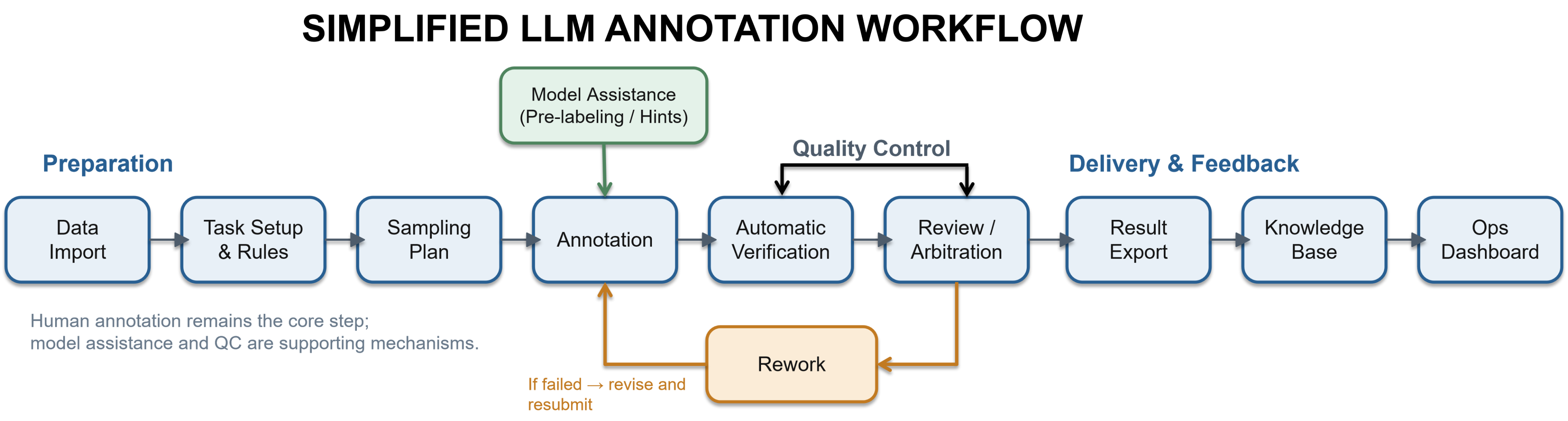
Figure 14-1: LLM Annotation Platform Workflow Diagram
Table 14-1 summarizes the corresponding comparison and engineering considerations.
Table 14-1: Annotation Role Responsibilities and Permissions
| Role | Core Responsibilities | Primary Permissions | Key Boundaries |
|---|---|---|---|
| Platform Administrator | Maintain the system, configure processes, manage templates and permissions | Create templates, configure workflows, manage accounts, view full audit logs | Does not directly participate in routine quality adjudication to avoid role conflicts |
| Project Operations | Manage batch launches, distribution, progress, and scheduling | Create task batches, distribute tasks, view operational reports, trigger rework processes | Must not exceed authority to modify QA rules or arbitration decisions |
| Annotator | Execute annotation, revision, and comparative judgments | Accept tasks, submit results, view guidelines and example library | Must not see golden set identifiers, arbitration rules, or other teams' private information |
| Pre-Reviewer | Conduct the first round of rule checks and low-level error screening | Reject, rework, apply error tags, add problem notes | Generally not responsible for final adjudication of complex disputed samples |
| Secondary Reviewer | Review high-risk or priority tasks to maintain quality standards | Approve, reject, escalate to arbitration, add supplementary QA comments | Must not bypass the process to directly rewrite results without leaving a trace |
| Arbitrator / Expert | Adjudicate disputed samples and update boundary rules | Issue final verdicts, publish precedents, drive rule revisions | Must not be overwhelmed by large volumes of routine review, or they become a bottleneck |
| QA Manager | Monitor consistency, spot-check strategy, and quality fluctuations | Configure sampling ratios, view quality dashboards, analyze error distributions | Does not directly replace frontline QA by making all individual case judgments |
| Vendor Supervisor | Organize the outsourced team's execution, training, and assessment | View team performance, rework rate, SLA attainment | Manages own team only; must not access other vendors' data |
| Model / Automation Assistant | Provide pre-annotation, risk alerts, and structured suggestions | Generate candidates, flag anomalies, suggest rework reasons, assist with clustering | May only provide suggestions; cannot bypass human review to directly enter the official dataset |
14.3 QA System and Consistency Management
14.3.1 Combining Pre-Review, Secondary Review, Arbitration, Spot-Checking, and Blind Review
In LLM data production, one of the most dangerous misconceptions is treating quality inspection as "taking a final look." The implicit logic behind this view is: annotators do the work first, QA reviewers spot-check at the end, and as long as there are no major issues, data can enter the repository. But the real risk is precisely that many errors in LLM tasks have already moved beyond the category of low-level errors and more often manifest as systemic biases, boundary misjudgments, and standard drift. If relying only on final spot-checking, these problems are typically discovered too late and are difficult to correct. Crowdsourcing annotation quality research and redundant annotation research both demonstrate that annotation quality must be continuously controlled through task design, repeated judgments, aggregation mechanisms, and calibration—it cannot rely only on end-stage spot-checking (Snow et al. 2008; Sheng et al. 2008; Dawid and Skene 1979).
Therefore, the QA system must be designed as a combination mechanism rather than a single action. The value of pre-review is to intercept obviously unqualified results as early as possible—format violations, missing fields, severe off-topic responses, clear safety risks, and mechanical perfunctory answers. Pre-review does not aim to make precise judgments on all complex problems; it acts more like a first filter, removing at low cost content that should never flow into subsequent processes. This way, secondary-review resources are not consumed by large volumes of low-quality samples.
Secondary review handles higher-level quality judgments. Beyond surface compliance, it examines whether content is adequate, logic is rigorous, comparative judgments are well-reasoned, and review-style revisions genuinely improve the original answer. For complex tasks, secondary review is often the critical link that determines the final quality level, because many samples that appear acceptable during pre-review only reveal problems upon deeper examination.
Arbitration handles disputes and edge cases. The value of arbitration is far more than "rendering a final verdict"; more importantly, it is the source of rule system updates. Whenever a case enters arbitration, it indicates that the current specifications may contain ambiguities, or that different roles do not share a consistent understanding of the rules. If arbitration only produces individual-case conclusions without converting them into rule supplements, example updates, or training materials, the organization will encounter the same type of dispute in the next round. That is, arbitration not only resolves sample-level problems but also repairs the rule system.
The role of spot-checking is to monitor overall quality levels. Even in a project with pre-review and secondary review, it cannot be assumed that total quality is naturally stable. As task types change, vendors rotate, and personnel turn over, the system can easily exhibit gradual drift. Spot-checking—by periodically examining random or priority samples—helps managers determine whether quality has shifted at the aggregate level. Blind review further identifies potential biases by hiding certain information, observing whether different reviewers reach consistent judgments when not influenced by each other, and thereby discovering hidden biases arising from scoring habits, team culture, or prior impressions.
Therefore, the QA system should not be designed as a single interception point but should be understood as a quality network that is layered, role-divided, and risk-differentiated. Pre-review handles early filtering; secondary review handles key gatekeeping; arbitration resolves disputes and updates rules; spot-checking monitors overall quality; blind review surfaces hidden biases. Only when all these links together form a closed loop can quality control be genuinely stable.
14.3.2 Consistency Metrics, Error Tags, and Quality Tiering
One of the most challenging aspects of LLM data annotation is that it inherently involves a relatively high proportion of subjective judgment. Many teams, upon hearing the word "subjective," tend toward one of two extremes: either believing that subjectivity makes quality unmanageable, or attempting to eliminate all variation through extremely rigid rules. Neither approach is tenable. Subjectivity in LLM tasks does not mean quality is unmanageable; it requires the organization to use finer structure to decompose "subjective judgment" into multiple dimensions that can be trained, audited, and compared.
Consistency metrics become important in this context. Their significance goes beyond showing "whether different annotators agree"—more importantly, they help the organization identify whether the current judgment system is stable. Cohen's Kappa, Fleiss' Kappa, Krippendorff's Alpha, and inter-coder agreement research in computational linguistics are all classic tools and surveys for measuring and interpreting annotation consistency (Fleiss 1971; Krippendorff 2004). If secondary reviewers frequently disagree on a certain task type, this indicates that rule boundaries may be unclear or that personnel understand the relative weights of different quality dimensions differently. Consistency metrics should therefore not be treated as static scores; they function more like diagnostic signals—reminding managers whether current standards are sufficiently clear, whether training is effective, and whether examples cover high-frequency edge-case scenarios.
To make consistency interpretable, the platform must establish an error tag taxonomy. The objective of error tags is not to increase recordkeeping burden but to convert "what's wrong" from a vague impression into a structured attribution. Factual errors, instruction deviation, information omission, format non-compliance, safety boundary issues, reasoning breaks, stylistic deviation, and inadequate review—these categories are not designed to look good in statistics; their true function is to help the organization identify exactly where and in which workflows, teams, and task types quality problems are concentrated. Once errors are tagged, QA and operations can shift from "the feeling that quality has been poor recently" to a more actionable judgment such as "factual errors have been notably increasing in comparative annotation tasks from a specific vendor."
Quality tiering is the further governance step built on top of consistency and error tags. Not all samples require the same level of review investment, and different errors carry different consequences. For high-risk, high-value, open-ended tasks, the organization should accept higher review costs in exchange for more stable quality. For low-risk, highly structured tasks, stronger front-end template constraints and automated checks can appropriately reduce manual review load. The core of quality tiering is ensuring that samples of different risk levels enter QA paths of different intensity—avoiding cost overruns from "reviewing everything heavily" while also avoiding quality failures from "reviewing everything lightly."
In essence, consistency metrics, error tags, and quality tiering all address the same problem: how to transform complex LLM quality judgments from an experiential level into organizationally governable objects. Without consistency metrics, the team doesn't know whether standards are truly shared. Without error tags, the team doesn't know where problems originate. Without quality tiering, the team cannot direct limited resources toward the highest-value areas.
The following snippet focuses on Using Cohen's Kappa to Monitor Dual-Review Consistency (Minimal Implementation).
Agreement rate only checks "same / different," whereas Kappa additionally discounts "chance agreement" and is more appropriate for long-term comparison of stability across different task buckets. Cohen's original Kappa coefficient was proposed precisely to correct for chance agreement in nominal-scale annotation (Cohen 1960).
Listing 14-2 provides a process flow example.
from collections import Counter
from typing import List


def cohen_kappa(a: List[str], b: List[str]) -> float:
    assert len(a) == len(b) and len(a) > 0
    n = len(a)
    po = sum(1 for i in range(n) if a[i] == b[i]) / n

    ca, cb = Counter(a), Counter(b)
    labels = set(ca) | set(cb)
    pe = sum((ca[l] / n) * (cb[l] / n) for l in labels)

    if pe == 1.0:
        return 1.0
    return (po - pe) / (1 - pe)


if __name__ == "__main__":
    r1 = ["pass", "pass", "reject", "pass", "reject"]
    r2 = ["pass", "reject", "reject", "pass", "reject"]
    print("kappa =", round(cohen_kappa(r1, r2), 4))
Listing 14-2: Process flow example
14.3.3 How to Use Golden Sets, Trap Questions, and Audit Samples
In any large-scale annotation system, routine review is insufficient on its own. Once the process becomes familiar to participants, the team may exhibit mechanical responses, sycophantic answers, declining attention, or "only being careful about the parts most likely to be observed." To prevent the system from gradually distorting behind a surface appearance of stability, organizations need to actively plant special samples with calibration and audit functions into the process. The three most important types are golden sets, trap questions, and audit samples. Crowdsourcing annotation research commonly uses expert labels, redundant annotation, task design, and behavioral verification to improve or assess annotation quality, providing the methodological basis for the use of golden sets and trap questions (Snow et al. 2008; Sheng et al. 2008; Kittur et al. 2008).
Golden sets are collections of samples with relatively stable answers, clear standards, and high adjudication confidence. Their first function is calibration. New annotators can be tested on the golden set before entering the system to verify whether they have mastered the basic rules. Existing teams can also have golden set items periodically inserted during ongoing operation to detect whether standards have drifted. Golden sets can additionally serve as scoring anchors, helping different reviewers maintain similar judgment baselines over extended work periods. Golden set items should not all be the simplest possible tasks; they should cover high-confidence standard cases at different difficulty levels.
Trap questions focus not on difficulty but on whether they can expose perfunctory, inattentive, or opportunistic behavior. For example, if a sample includes a very obvious formatting requirement that the annotator still ignores, this suggests they may not have read carefully; if a question clearly triggers a safety red line and the result shows no alertness whatsoever, the annotator's execution strategy has obvious gaps. Trap questions are not intended to replace normal QA; they serve more as behavioral detectors, helping the organization identify which errors stem from capability gaps and which stem from attitude issues or process fatigue.
Audit samples lean more toward system diagnostics. They typically cannot be treated simply as "right-or-wrong problems" because their value lies in their typicality at boundary areas and their ability to expose rule-interpretation discrepancies. Organizations can periodically deploy the same batch of audit samples to different teams, different vendors, or reviewers in different time windows, to observe whether the system exhibits standard drift. The significance of audit samples lies not in whether they should enter the training set but in whether they can help managers determine: is this system still operating according to the same set of standards?
From a usage perspective, the three types should not be conflated. Golden sets are best suited as admission, calibration, and ongoing monitoring tools; trap questions are best suited as behavioral and process-discipline check tools; audit samples are best suited as system consistency and organizational drift diagnostic tools. If the three are mixed together, teams may see only scores without understanding the different governance purposes behind them.
14.3.4 Human–Machine Collaborative QA Loop
In LLM projects, relying on manual QA alone will quickly hit cost and timeliness ceilings. When task volume grows large, it is difficult for humans to check all content at high frequency, in full, and with sustained consistency; when tasks are complex, reviewers can easily miss critical issues under fatigue. Human–machine collaborative QA is therefore becoming an increasingly important direction. It must be emphasized, however, that the emphasis of human–machine collaboration is not "having the model replace quality inspectors" but having the model handle high-recall, low-cost front-end screening while humans focus on high-precision, high-value judgments. Active learning emphasizes concentrating manual annotation resources on higher-information samples; weak supervision systems emphasize combining heuristic rules, model output, and human knowledge into learnable signals—both types of research support the "machine screens, human adjudicates" design pattern (Settles 2009; Ratner et al. 2017).
An effective human–machine collaborative QA path typically begins with model pre-screening. The model first performs a structural scan of results—checking for missing fields, off-topic responses, obvious safety risks, triggered high-frequency error patterns, or ranking samples by risk level. Subsequently, human pre-reviewers no longer start from a completely blank state; they can use the model's hints to judge which flagged issues are genuine, which are false positives, which should go directly to rework, and which should proceed to secondary review or arbitration.
More importantly, this process should not stop at "the model takes a look first." Every instance of a human reviewer rejecting, approving, escalating to arbitration, or adding an error tag is in fact providing feedback signals to the model. If the platform can retain these signals, it can gradually improve the model's risk rules, prompt templates, or detection capabilities. RLHF, DPO, and weak supervision methods all show that human judgments, preference results, or rule functions can only be converted into downstream training or screening capability when they are preserved in a structured form (Ouyang et al. 2022; Ratner et al. 2017). At the same time, high-value cases generated during secondary review and arbitration should also be simultaneously fed back into the knowledge base and example library, further supporting subsequent QA and training. In this way, QA forms a genuinely closed loop: the model assists in discovering problems, humans are responsible for adjudication and explanation, adjudication results are retained as knowledge, and this knowledge in turn improves the model's and the process's performance in the next round.
From a management perspective, the core of human–machine collaborative QA lies not in automation rate but in observability and accountability boundaries. The system must be able to answer: was a given problem flagged by the model or actively discovered by a human; was a given rework triggered by a model false positive or a human missed judgment; why did a particular error tag suddenly increase—did a rule change, or did a model threshold change? Only when this information is traceable is human–machine collaboration under control; otherwise, it merely introduces a new opaque variable into the system.
Figure 14-2 illustrates the corresponding workflow or structure.
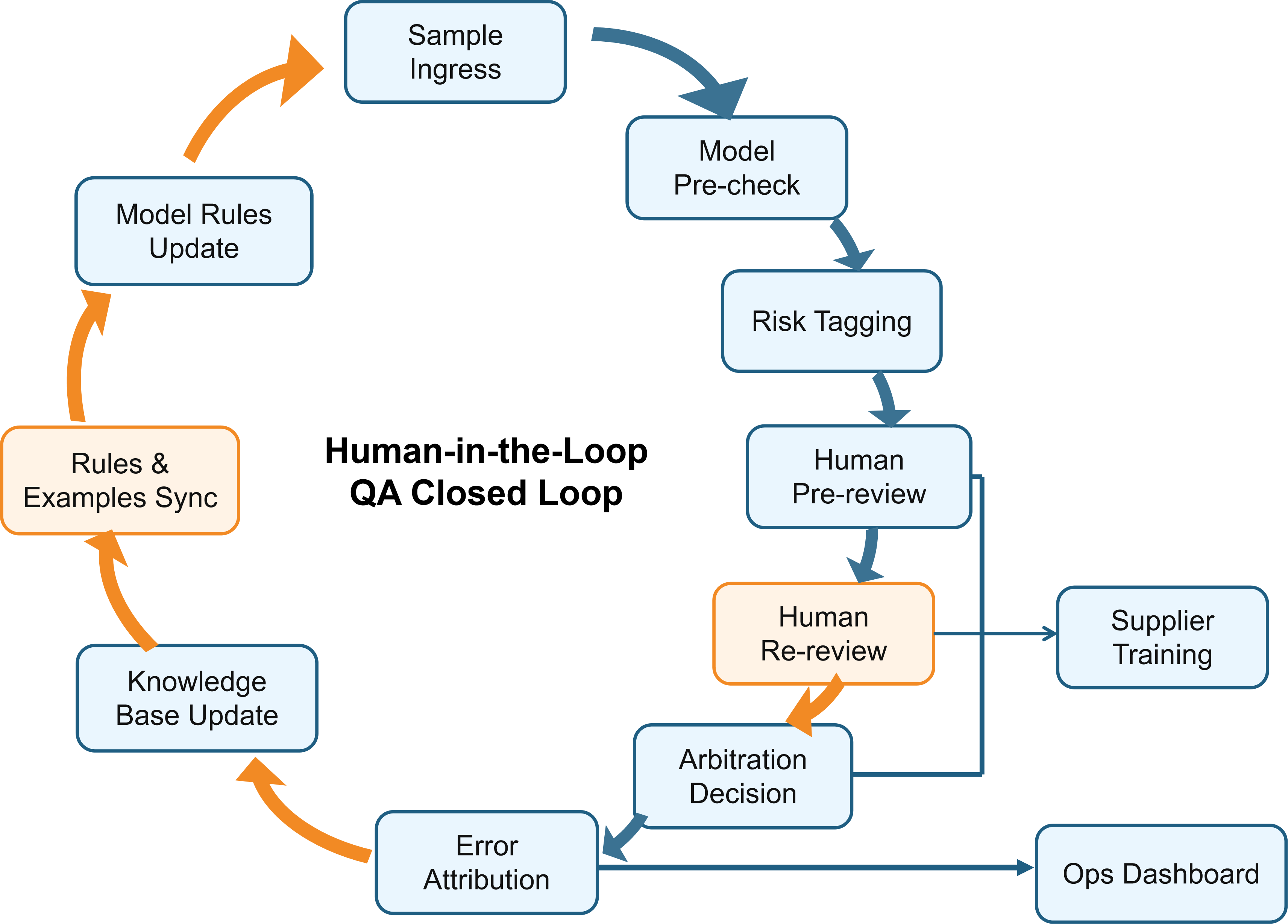
Figure 14-2: Human–Machine Collaborative QA Loop Diagram
14.4 Operational Metrics and Vendor Governance
14.4.1 Four Core Operational Metric Categories: Productivity, Quality, Cycle Time, and Cost
Once annotation moves from project trial operation into continuous production, operational work can no longer remain at the level of "how much was done today, how much is left." The difficulty of LLM data production lies not necessarily in the tasks themselves being harder; the key is that multiple objectives must be simultaneously met: sufficient output and stable quality; timely delivery without allowing excessive rework to consume resources; cost control without allowing price pressure to drive overall quality downward. Operations must therefore establish a metric system capable of simultaneously observing efficiency, quality, time, and investment. Data quality assessment research emphasizes combining subjective evaluations, objective measurements, and improvement actions, rather than looking at only a single outcome metric (Wang and Strong 1996; Pipino et al. 2002).
Productivity metrics examine how much genuinely usable data is produced per unit of time. The keyword here must be "usable," not "submitted." A team that submits many items most of which require rework or fail secondary review may appear busy but is not actually highly productive. Productivity judgments in LLM projects must be coupled with QA results to avoid the systemic harm caused by single-mindedly pursuing speed.
Quality metrics are the part operations must continuously monitor. Beyond commonly used metrics such as first-pass rate, secondary review pass rate, and rework rate, attention should also be paid to golden set performance, consistency levels, arbitration dispute rate, and error tag distribution—because quality problems typically do not manifest first as "total collapse," more commonly presenting as a certain error type quietly rising in a certain team. If operations only watches a single overall pass rate, these early signals are easily missed. Consistency metrics and latent true-label estimation methods provide foundational tools for multi-annotator quality monitoring (Dawid and Skene 1979; Krippendorff 2004).
Cycle time metrics reflect whether the process runs smoothly. The total time from a batch going live to data release, how long rework closure takes, whether secondary review and arbitration exhibit prolonged backlogs—all directly affect the project's responsiveness. Especially in rapid LLM iteration scenarios, the value of data does not increase automatically with volume; it depends more on whether the data is timely and adapted to current requirements. Cycle time loss often indicates problems in process design, scheduling strategy, or review load.
Cost metrics must be understood with greater precision. Many teams focus only on per-unit pricing, but what truly matters is per-usable-unit cost. A vendor that appears inexpensive, if it generates many rework items, creates heavy QA pressure, requires repeated training, and produces unstable standards, may ultimately cost more per genuinely usable data item than a more expensive vendor. Cost governance therefore cannot be viewed independently of quality and cycle time—it must be measured within the context of the whole system.
The following snippet focuses on Calculating "Per-Usable-Unit Cost / Pass Rate" Using SQL (Illustrative).
Once operational metrics are expressed in data tables, many conclusions no longer depend on "gut feeling." The example below assumes an annotation_tasks table (each row represents a submission/review event) and allows rapid derivation of commonly used KPIs.
Listing 14-3 provides an SQL query example.
-- Illustrative only: adjust field names to match your actual schema
WITH latest AS (
  SELECT
    sample_id,
    MAX(event_time) AS latest_time
  FROM annotation_tasks
  WHERE batch_id = 'BATCH_2026_04_24'
  GROUP BY sample_id
),
final_state AS (
  SELECT t.sample_id, t.final_status, t.total_cost
  FROM annotation_tasks t
  JOIN latest l
    ON t.sample_id = l.sample_id AND t.event_time = l.latest_time
),
base AS (
  SELECT
    COUNT(*) AS total_samples,
    SUM(CASE WHEN final_status = 'accepted' THEN 1 ELSE 0 END) AS accepted_samples,
    SUM(total_cost) AS total_cost
  FROM final_state
)
SELECT
  total_samples,
  accepted_samples,
  CAST(accepted_samples AS FLOAT) / NULLIF(total_samples, 0) AS acceptance_rate,
  total_cost,
  total_cost / NULLIF(accepted_samples, 0) AS cost_per_accepted_sample
FROM base;
Listing 14-3: SQL query example
14.4.2 Outsourced Team Selection, Training, Assessment, and Replacement Mechanisms
Once LLM data production scales up, organizations almost inevitably need to work with outsourced or vendor teams. Many projects that suddenly destabilize after expansion typically do not fail because the tasks themselves changed; the root cause is that organizations underestimate the complexity of vendor governance. Treating vendors as "more hands" is extremely dangerous, because they are in fact extensions of the quality system—the true execution-layer carriers of the platform, processes, and knowledge base.
Vendor selection should not focus only on price and nominal headcount. More important is whether the vendor has a mature team-lead structure, training mechanisms, QA collaboration capabilities, response speed, and cross-time-zone collaboration experience. Some teams charge low per-unit prices and have large headcounts but lack middle management and rule-internalization capability, ultimately shifting large governance costs to the client. Other teams may charge slightly more but can absorb complex tasks more stably, reducing rework and communication friction. A mature manager evaluates "total governance cost," not "surface unit price."
Training also cannot remain a one-time kickoff briefing or document distribution. In LLM tasks especially, many rules cannot be grasped by reading them once; they must be gradually internalized through examples, trial annotation, retrospectives, and calibration. Effective training should include at minimum four components: rule explanation, typical error analysis, edge-case discussion, and hands-on practice with golden-set items. More importantly, training must be bound to the actual task at hand, avoiding abstract principle lectures. Only when training materials closely correspond to the current batch of tasks will the team genuinely develop execution consistency. Non-expert annotation research shows that task design, examples, and quality calibration can to some extent improve the usability of non-expert annotation results, but must be combined with ongoing calibration (Snow et al. 2008; Kittur et al. 2008).
Assessment should not only examine overall pass rate, because a team may perform well on simple tasks but persistently fail on critical high-risk tasks. If assessment dimensions are too coarse, the organization is deceived by averages. A more reasonable approach is compound assessment by task type, risk level, error tag distribution, golden set performance, and SLA attainment. This makes assessment results genuinely informative for allocation, training, and replacement decisions.
The replacement mechanism also needs to be institutionalized. Many teams only decide to replace a vendor when it has already severely set the project back, by which time a heavy price has already been paid. A more mature approach is to define explicit warning and exit conditions—for example, consecutive multi-cycle SLA failures, persistent deterioration of critical error types, no improvement after training, or continued large calibration discrepancies after cross-team calibration. Once thresholds are triggered, flow-restriction, remediation, or replacement processes should be initiated rather than continuing to rely on ad-hoc coordination to delay the problem.
14.4.3 Annotator Training and the Case Library
Once the annotation system truly enters large-scale operation, annotator training can no longer be understood as a one-time action before project launch. Many teams invest considerable time in training, yet still encounter recurring standard drift, low-level rework, and edge-case disputes—often because training has not formed a closed loop with the case library, QA feedback, and ongoing calibration mechanisms. In LLM data production, annotators cannot simply execute fixed labels; they must make constrained judgments in complex contexts. The objective of training is therefore to progressively equip them with a reusable, calibratable, and traceable judgment capability.
Effective training first requires establishing a pre-task example system. Training examples are designed around the core competencies required for the current task. For Q&A annotation, this covers information completeness, factual consistency, expressive clarity, and safety boundaries; for preference comparison, it covers situations where candidate differences are obvious, subtle, each with strengths and weaknesses, and both unacceptable; for review-style revision, it covers local polishing, structural rewriting, factual correction, and rejection of revision. The more closely training examples correspond to the judgment load in real production, the smaller the comprehension gap when annotators enter formal tasks.
Equally important as positive examples is the counterexample library. Many quality problems recur not because annotators are completely unfamiliar with the rules but because they fail to realize that certain seemingly reasonable processing approaches are in fact incorrect given the task objective. For example, an answer may look comprehensive but introduce information not supported by the original source; a refusal may appear safe but overly refuses an ordinary question that should have been answered; a preference choice may appear to select the more fluent option but ignores a factual error; a review revision may produce prettier text but changes the core meaning of the original answer. If these errors are only pointed out case-by-case during rework, large-scale improvement is difficult. Only by retaining them in a counterexample library with clearly marked error types, triggers, and correction methods can training shift from "articulating principles" to "identifying error patterns."
Gray-area judgment is the part of the training system that best reveals organizational capability. LLM annotation tasks contain a large number of situations that cannot be fully covered by a single rule—such as trade-offs between safety and helpfulness, between conciseness and completeness, between fidelity to the original and reasonable supplementation, and whether to ask a follow-up question when user intent is unclear. For these gray areas, managers cannot simply ask annotators to "judge by feel," nor push all cases to back-end arbitration. A more reasonable approach is to build a gray-area case library: continuously incorporating high-frequency disputed samples, arbitrated samples, cross-vendor disagreement samples, and new boundary samples introduced by model iteration, recording the final ruling, ruling rationale, and scope of applicability for each case. In this way, gray areas no longer exist only in individual experience but progressively transform into a shared precedent system for the team.
Ongoing calibration mechanisms determine whether training remains effective over the long term. A single training session can only address understanding alignment at the launch stage; it cannot guarantee that standards will not drift in subsequent weeks or months. As task batches change, rule versions update, model capability evolves, and personnel turn over, annotation team judgment standards naturally shift. Therefore, a mature data operations system should establish a fixed calibration rhythm—for example, small-scale trial annotation before a new batch launches, high-frequency spot-checking during the early stages of formal production, focused retraining after rule updates, cross-calibration across multiple vendors, and short-cycle retrospectives targeting high-frequency error tags. Calibration should examine not only pass rates but also whether error types are clustering, whether different teams show widening disagreement on the same gray areas, and whether inconsistent interpretations of the same rule version appear.
From a platform perspective, training examples, the counterexample library, gray-area cases, and calibration records should not remain in offline documents. They should be bound to task versions, guideline versions, template fields, and the QA manual. When annotators execute a task, they should be able to see corresponding examples beside the relevant fields; when QA reviewers reject items, they should be able to cite counterexamples or gray-area precedents; when operations conducts retrospectives, they should be able to track training effectiveness by error tag and team dimension. Only when the case library is genuinely embedded in the platform and processes does training cease to be a one-time broadcast and instead become a mechanism through which the data production system continuously self-corrects.
Therefore, annotator training and case library construction are not peripheral aspects of personnel management but important components of the quality governance system. Training is responsible for bringing personnel into the same judgment framework; the counterexample library surfaces common error patterns; the gray-area case library retains complex adjudication experience; and the ongoing calibration mechanism prevents standards from drifting over time. The four together enable annotation teams to maintain relatively stable execution consistency even as scale expands, tasks change, and personnel turn over.
14.4.4 Scheduling Strategies for Cross-Time-Zone, Multi-Vendor, Multi-Task-Type Operations
When a project enters the multi-team parallel phase, scheduling is no longer simply a question of "who is working today" but becomes a resource allocation and process governance design problem. Especially with cross-time-zone, multi-vendor, multi-task-type parallel operations, incorrect scheduling strategies directly amplify quality drift and communication delays, while well-designed scheduling can significantly improve system stability.
The advantage of cross-time-zone collaboration is that it can extend production coverage time, keeping the project running continuously over a longer daily window. But its hidden costs are also significant: rule updates are more easily delayed, rework closure loops slow down, and problem explanations are more easily distorted through multiple relay transmissions. Therefore, not all tasks are suited for cross-time-zone pipeline production. Tasks with unstable rule boundaries, frequent disputes, and frequent need for communication and rapid adjudication are generally better executed in time windows with shorter communication chains and faster feedback. Conversely, large batches of structurally clear, rule-mature, lower-risk tasks are better suited for continuous processing by cross-time-zone teams to maximize throughput.
In multi-vendor parallel operations, standard alignment must also be considered. Different vendors often have different management habits and execution cultures; without a shared calibration mechanism, a situation of "everyone appears to be following the rules but each doing their own thing" easily arises. Therefore, cross-vendor scheduling should consider not only who is available but also whether periodically shared calibration samples, shared audit samples, and synchronized version update schedules are in place. Without these mechanisms, multiple vendors actually cause consistency to deteriorate rapidly. Cross-team consistency can be monitored through metrics such as Kappa and Alpha, but these metrics still need to be interpreted in conjunction with error tags and case retrospectives (Artstein and Poesio 2008; Krippendorff 2004).
In multi-task-type parallel operations, scheduling must also account for the cognitive switching cost. Some teams mix all tasks together, having the same people simultaneously handle multi-turn dialogue, preference comparison, and review-style annotation, with both productivity and quality suffering. This is because different tasks require different judgment modes and attention structures, and frequent switching incurs significant cognitive load. A more reasonable approach is generally to group scheduling by task type or similar capability requirements, concentrating personnel on the same type of task within a given time window, thereby reducing switching overhead and improving judgment stability.
14.4.5 Annotation Productivity and Cost Governance
In the LLM data production process, efficiency improvement and cost control are frequently emphasized as important management objectives. However, in practice these objectives are sometimes narrowly understood as accelerating manual processing pace or compressing per-unit task costs. This approach may appear effective in the short term but tends to backfire over time. In data production systems, what matters most is not surface speed and price but rather how much genuinely usable, reusable, and model-iteration-supporting data each unit of resource ultimately yields.
True annotation productivity is not about how many items each person completes per day but about how many effective data items can be stably produced per person-hour, per review resource unit, and per platform investment unit—given a fixed quality constraint. Productivity improvement typically cannot be achieved by simply pushing people to work faster; it depends more on improved task modeling, reduced low-level rework, optimized template constraints, higher front-end screening precision, and genuine reduction of repetitive labor through human–machine collaboration. In other words, productivity improvement comes more from system design optimization than from intensifying human pressure. The shared goal of active learning and weak supervision is also to obtain usable training signals with less and more targeted human investment (Settles 2009; Ratner et al. 2017).
Cost governance should follow the same logic. Reducing per-unit price is certainly one approach, but it is by no means the most important. More important is reducing wasteful costs—for example, large amounts of rework caused by coarse templates, repeated training caused by chaotic rule updates, resource waste caused by excessively heavy review paths, and recurrence of the same type of error caused by insufficient knowledge retention. What a mature organization truly needs to calculate is not "how much cheaper was this batch today" but "does this system allow us to reduce wasteful consumption across the next several rounds of production?"
Therefore, productivity governance and cost governance must be considered jointly with platform design, QA design, and knowledge retention. The more structured the platform makes tasks, the more reasonably human–machine collaboration is embedded, the clearer the QA path tiering, and the more timely the knowledge base is updated—typically the lower the per-usable-data-item cost. What LLM data production truly requires is not point-in-time savings but systematically directing expenditure toward the areas most capable of improving usable output.
Table 14-2 summarizes the corresponding comparison and engineering considerations.
Table 14-2: Operational Metrics and SLA Reference Table
| Metric Category | Metric Name | Definition | Typical Monitoring Frequency | Reference SLA Example | Typical Governance Action |
|---|---|---|---|---|---|
| Productivity | Effective output per person-hour | Ratio of samples passing QA to person-hours worked | Daily / Weekly | Establish baselines by task type and continuously calibrate | Optimize templates, adjust distribution, strengthen human–machine collaboration |
| Productivity | First-submission pass rate | Proportion of samples that pass on first submission | Daily / Weekly | Maintain at a stable high-band level | Update example library, conduct targeted training on high-frequency problems |
| Quality | Secondary review pass rate | Proportion of secondary-review samples that ultimately pass | Daily / Weekly | Trigger quality investigation when below threshold | Analyze error tags, identify underperforming teams |
| Quality | Arbitration dispute rate | Proportion of arbitrated samples relative to total samples | Weekly | Keep at a low level; investigate abnormal spikes | Revise boundary rules, supplement precedents |
| Quality | Golden set accuracy | Standard hit rate on golden set samples | Daily / Weekly | Used as admission and advancement criterion | Recalibrate; restrict access to high-risk task types |
| Quality | Consistency score | Degree of agreement in dual- or multi-reviewer tasks | Weekly | Set minimum thresholds by task type | Organize calibration sessions; redesign scoring dimensions |
| Cycle Time | Average delivery cycle | Total time from batch launch to data release | Daily / Weekly | Routine tasks must meet fixed time limits | Adjust scheduling; relieve secondary-review backlogs |
| Cycle Time | Rework closure duration | Time from a sample being rejected to re-approval | Daily / Weekly | Extended duration indicates a clogged communication chain | Improve rework note quality; shorten decision chains |
| Cost | Per-usable-unit cost | Total investment divided by final usable sample count | Weekly / Monthly | Keep within budget and optimize each period | Reduce rework, minimize repeated training and over-review |
| Cost | QA cost share | QA person-hours as a proportion of total person-hours | Weekly / Monthly | Adjust dynamically with task maturity | Use models for high-recall screening; focus humans on high-value judgments |
| Vendor Governance | SLA attainment rate | Proportion of compliant batches out of total batches | Weekly / Monthly | Used as the basis for partnership continuation and capacity expansion | Reward/penalty, flow restriction, remediation, or replacement |
14.5 Knowledge Retention and Case Management
14.5.1 Building the Annotation Knowledge Base, QA Manual, and Retrospective Repository
Whether an annotation system can truly move from a project model to a capability model depends not on how much data is produced at any given time but on whether the system can preserve experience. Many teams in their early phases depend on one or two strong managers who rely on their personal knowledge to remember rules, monitor processes, interpret disputes, and drive training. In the short term, this can keep the project running. But once personnel change, projects multiply, or tasks run in parallel, this model rapidly reveals its fragility. If knowledge exists only in individuals' heads, it can never become organizational capability.
The knowledge base is the most basic and most critical retention infrastructure. It should not merely be a document repository but should be organized around task types, rule versions, error tags, edge cases, arbitration precedents, and high-frequency Q&As. For annotators, the knowledge base should help answer "how was this type of problem handled previously?"; for QA reviewers, it should help answer "why was it handled that way?"; for operations, it should help identify "which problems have been recurring recently?"; for the platform and model R&D teams, it should also provide structured material for template optimization, rule automation, and model assistance. The labeling functions and rule-based supervision ideas in weak supervision systems also demonstrate the value of structuring expert knowledge before using it for model training or data screening (Ratner et al. 2017).
The QA manual places greater emphasis on actionability. The knowledge base can be rich in content, but frontline execution does not always have time to search through complex materials for full background context. A more compact, action-oriented manual is therefore needed. It should specify which situations trigger direct rework, which must be escalated to secondary review or arbitration, which errors warrant sample rejection, and which situations should trigger focused spot-checking or recalibration. In other words, the knowledge base is more like long-term memory, and the QA manual is more like the current operating procedure. Both must be interlinked: the former provides deep foundations; the latter provides immediate execution norms.
The retrospective repository is the third critical infrastructure layer. Many organizations know they should summarize experience, but when actually conducting retrospectives they typically write only a project closure report that no one looks at afterward. A high-quality retrospective repository should structurally document major quality fluctuations, critical incidents, rule revisions, vendor instability, rework peaks, and high-frequency arbitration topics that occurred during the project. Beyond recording "what happened," it should include "why it happened," "how it was handled at the time," and "what mechanisms were subsequently repaired." Such material is far more valuable than generic experience summaries when the next round of projects launches.
14.5.2 Most Common Design Errors at Platform Launch
Based on extensive project experience, the most common errors at platform launch typically are not technical bugs but lie in the design assumptions themselves. The first common error is building the platform as a task form system—focusing only on import, distribution, and submission—without embedding quality control actions into the process. The result is that QA, rework, arbitration, and knowledge retention all depend on offline patches, causing the system to grow increasingly fragmented as it runs.
The second common error is treating QA as a final spot-check. Teams assume that letting data run first and then catching problems during later sampling is acceptable. But in LLM contexts, once errors enter production flow at scale, post-hoc remediation is extremely costly, and some systemic biases are difficult to fully reverse. Without front-loading QA into the process, it cannot genuinely fulfill a quality control role.
The third common error is excessively coarse task modeling. Complex Q&A, review, or preference tasks are compressed into a free-text box or a simple label, appearing flexible but actually transferring all problems that should have been resolved at the front end to the back-end review. The configuration cost saved on the front end is ultimately repaid with higher rework rates and review costs.
The fourth common error is neglecting version management. Rules change, examples are updated, templates are revised—but different teams use different versions, and in the end everyone believes they "followed the requirements," yet the system cannot achieve consistency. The fifth common error is introducing model assistance too early and too optimistically without clearly defining the boundary between model suggestions and human adjudication. This causes the model to shift from a system-helping tool to a source of new opacity and risk. The sixth common error is focusing only on price without examining per-usable-unit cost, leading to low-price teams actually becoming the most expensive choice due to high rework, high communication overhead, and high QA load.
These errors are high-frequency not because teams are unprofessional but because many organizations in their early stages still interpret platform construction through a project-delivery mindset. They focus on "get it live first, get it running," without treating the platform as the infrastructure for future quality mechanisms and organizational experience. Once scale increases, all design elements that were skipped early on will be paid back at higher cost.
14.5.3 From Cases to Organizational Capability: How to Make Knowledge Genuinely Retained
The truly difficult part of knowledge retention is not "writing things down" but ensuring that what is written continues to be used in subsequent processes. Many teams do record cases, write FAQs, and conduct retrospectives, but this content often remains in static documents without re-entering the platform, processes, and training system. The result is that knowledge clearly exists yet fails to change future execution behavior.
For knowledge to be genuinely retained, the key is transforming cases into rules, rules into templates, templates into platform constraints, and platform constraints into the default operating patterns of subsequent teams. A high-frequency dispute case, if it only lives in a document, will likely never be seen by the next new recruit; but if it enters the example library, is updated in the QA manual, is synchronized into template field descriptions, and recurs in golden sets and training sessions, then it has truly been converted into organizational memory. This process shares the spirit of converting expert rules into composable training signals in weak supervision (Ratner et al. 2017).
Similarly, retrospectives should not only look backward but should drive system revisions. For example, if a vendor persistently exhibits context-omission problems in multi-turn dialogue tasks, the post-retrospective response cannot be merely reminding them to "read context carefully." It should also consider whether to add a conversation summary area to the template, whether to introduce a contextual consistency check in pre-review, whether to add targeted examples to training, and whether to redefine the distribution threshold for that task type. Only when retrospectives drive mechanism changes does experience stay out of the one-time domain.
Therefore, the ultimate objective of knowledge base construction is not accumulating as much material as possible but ensuring that this material can continuously change platform configuration, QA decisions, training content, and operational actions. The formation of organizational capability is reflected precisely here: it does not depend on a key individual making ad-hoc decisions but lets past cases continuously enter the system, allowing future projects to automatically possess the experience of the past when they launch.
Chapter Summary
In the era of large models, annotation work can no longer be understood as a simple task execution step. It is fundamentally a continuously operating data production system, and whether this system operates stably depends on whether the platform, QA, and operations are designed in a unified manner. The platform should be upgraded from a task-dispatching tool to a quality control system; QA should be upgraded from a final check to a layered mechanism that runs through task definition, execution, arbitration, and knowledge updates; and operations should be upgraded from scheduling and deadline-chasing to a governance hub connecting quality, cycle time, productivity, and cost.
Around this theme, this chapter first redefined the true objective of an annotation platform—emphasizing that the platform should carry responsibility for quality constraint, role control, process audit trails, and rule enforcement—and further analyzed the fundamental differences between LLM data annotation and traditional CV/NLP annotation, as well as the boundaries among platform capability, process capability, and operational capability. The chapter then focused on task modeling and workflow, discussing the different process requirements of single-turn Q&A, multi-turn dialogue, comparative annotation, and review-style annotation, along with the importance of sample distribution, permission control, progress monitoring, rework mechanisms, guideline management, and example library maintenance.
In the QA system section, the chapter explained the combined logic of pre-review, secondary review, arbitration, spot-checking, and blind review; the governance value of consistency metrics, error tags, and quality tiering; and the different roles of golden sets, trap questions, and audit samples in calibration and auditing. The chapter also incorporated human–machine collaboration into the quality control loop, noting that the model's value lies in high-recall screening and structured prompting, while human value lies in verification, explanation, adjudication, and knowledge retention.
In the data operations section, the chapter further discussed the coordinated governance of the four metric categories—productivity, quality, cycle time, and cost—vendor team selection, training, assessment, and replacement mechanisms, scheduling strategies for cross-time-zone, multi-vendor, and multi-task-type parallel operations, and the systemic logic of annotation productivity and cost governance. Finally, around knowledge base, QA manual, and retrospective repository construction, the chapter described the most common design errors at platform launch and emphasized that the ultimate destination of knowledge retention is not document accumulation but continuously converting experience into rules, templates, and platform capability.
In the final analysis, a mature annotation system should not depend on a small number of experienced individuals to reactively patch problems. Instead, it should make rules executable, processes traceable, quality auditable, operations governable, and knowledge retainable. Only when these capabilities are truly built will annotation work be elevated from repeated project-level deliveries to the data infrastructure supporting continuous LLM iteration.
References
Wang R Y, Strong D M (1996) Beyond Accuracy: What Data Quality Means to Data Consumers. Journal of Management Information Systems, 12(4), 5–33. DOI: 10.1080/07421222.1996.11518099.
Pipino L L, Lee Y W, Wang R Y (2002) Data Quality Assessment. Communications of the ACM, 45(4), 211–218. DOI: 10.1145/505248.506010.
Wei J, Bosma M, Zhao V Y, et al. (2022) Finetuned Language Models Are Zero-Shot Learners. International Conference on Learning Representations. arXiv:2109.01652.
Ouyang L, Wu J, Jiang X, et al. (2022) Training Language Models to Follow Instructions with Human Feedback. Advances in Neural Information Processing Systems, 35, 27730–27744. arXiv:2203.02155.
Christiano P F, Leike J, Brown T B, et al. (2017) Deep Reinforcement Learning from Human Preferences. Advances in Neural Information Processing Systems, 30. arXiv:1706.03741.
Stiennon N, Ouyang L, Wu J, et al. (2020) Learning to Summarize from Human Feedback. Advances in Neural Information Processing Systems, 33, 3008–3021. arXiv:2009.01325.
Bradley R A, Terry M E (1952) Rank Analysis of Incomplete Block Designs: I. The Method of Paired Comparisons. Biometrika, 39(3/4), 324–345. DOI: 10.2307/2334029.
Rafailov R, Sharma A, Mitchell E, et al. (2023) Direct Preference Optimization: Your Language Model is Secretly a Reward Model. Advances in Neural Information Processing Systems, 36. arXiv:2305.18290.
Zheng L, Chiang W-L, Sheng Y, et al. (2023) Judging LLM-as-a-Judge with MT-Bench and Chatbot Arena. Advances in Neural Information Processing Systems, 36. arXiv:2306.05685.
Bai Y, Kadavath S, Kundu S, et al. (2022) Constitutional AI: Harmlessness from AI Feedback. arXiv:2212.08073.
Snow R, O'Connor B, Jurafsky D, Ng A Y (2008) Cheap and Fast—But is it Good? Evaluating Non-Expert Annotations for Natural Language Tasks. Proceedings of the 2008 Conference on Empirical Methods in Natural Language Processing, 254–263.
Sheng V S, Provost F, Ipeirotis P G (2008) Get Another Label? Improving Data Quality and Data Mining Using Multiple, Noisy Labelers. Proceedings of the 14th ACM SIGKDD International Conference on Knowledge Discovery and Data Mining, 614–622. DOI: 10.1145/1401890.1401965.
Dawid A P, Skene A M (1979) Maximum Likelihood Estimation of Observer Error-Rates Using the EM Algorithm. Applied Statistics, 28(1), 20–28. DOI: 10.2307/2346806.
Artstein R, Poesio M (2008) Inter-Coder Agreement for Computational Linguistics. Computational Linguistics, 34(4), 555–596. DOI: 10.1162/coli.07-034-R2.
Cohen J (1960) A Coefficient of Agreement for Nominal Scales. Educational and Psychological Measurement, 20(1), 37–46. DOI: 10.1177/001316446002000104.
Fleiss J L (1971) Measuring Nominal Scale Agreement among Many Raters. Psychological Bulletin, 76(5), 378–382. DOI: 10.1037/h0031619.
Krippendorff K (2004) Reliability in Content Analysis: Some Common Misconceptions and Recommendations. Human Communication Research, 30(3), 411–433. DOI: 10.1111/j.1468-2958.2004.tb00738.x.
Kittur A, Chi E H, Suh B (2008) Crowdsourcing User Studies with Mechanical Turk. Proceedings of the SIGCHI Conference on Human Factors in Computing Systems, 453–456. DOI: 10.1145/1357054.1357127.
Settles B (2009) Active Learning Literature Survey. Computer Sciences Technical Report 1648, University of Wisconsin–Madison.
Ratner A, Bach S H, Ehrenberg H, et al. (2017) Snorkel: Rapid Training Data Creation with Weak Supervision. Proceedings of the VLDB Endowment, 11(3), 269–282. DOI: 10.14778/3157794.3157797.
Thurstone L L (1927) A Law of Comparative Judgment. Psychological Review, 34(4), 273–286. DOI: 10.1037/h0070288.